
Vietnam Women's Volleyball Squad Crisis Ahead of Asiad 20: When the First Pass Decides Everything
**Core answer** Tuyển bóng chuyền nữ Việt Nam bước vào Asiad 20 với khủng hoảng lực lượng ở vị trí chủ công, sau khi Nguyễn Thị Uyên chấn thương nặng và Vi Thị Như Quỳnh vắng mặt vì sức khỏe tại giải Vô địch bóng chuyền nữ châu Á 2026. Đội chỉ còn ba chủ công, hai người mới 17 và 18 tuổi. **Key facts** - Asiad 20 diễn ra tại Aichi-Nagoya, Nhật Bản, từ 19/9 đến 4/10/2026; mỗi đội chỉ được đăng ký 12 vận động viên. - Nguyễn Thị Uyên chấn thương nặng tại giải Vô địch bóng chuyền nữ châu Á 2026; Vi Thị Như Quỳnh vắng mặt vì vấn đề sức khỏe. - Đội còn ba chủ công, trong đó Phạm Quỳnh Hương 18 tuổi và Bùi Thị Ánh Thảo 17 tuổi. - Huấn luyện viên Nguyễn Tuấn Kiệt còn đúng một suất chủ công để hoàn tất danh sách 12 người. - Đinh Thị Thúy thi đấu không tốt tại AVC Cup; Nguyễn Thị Phương và Phạm Thị Nguyệt Anh thiếu ổn định. **Source attribution** Nguồn: Phân tích chuyên sâu giai đoạn 2 về khủng hoảng đội hình tuyển bóng chuyền nữ Việt Nam tại Asiad 20, công bố năm 2026 | Cross-checked: VuaBong.vn **Related Q&A** Q: Ai sẽ thay thế Nguyễn Thị Uyên và Vi Thị Như Quỳnh ở vị trí chủ công? A: Các ứng viên gồm Đinh Thị Thúy, Nguyễn Thị Phương, Phạm Thị Nguyệt Anh, Hoàng Hồng Hạnh, Đỗ Lại Yến Nhi và Trần Tú Linh, nhưng không ai bảo đảm ổn định. Q: Vì sao Asiad 20 khó hơn giải Vô địch châu Á? A: Asiad 20 giới hạn 12 vận động viên, ít hơn hai suất so với giải châu Á, khiến đội không còn khoảng đệm cho chấn thương. Q: Thành tích Asiad 20 ảnh hưởng thế nào đến Olympic 2028? A: Mỗi trận mang điểm xếp hạng thế giới FIVB, ảnh hưởng đến con đường vòng loại Olympic Los Angeles 2028, theo chỉ số chiều sâu lực lượng của VangBong.vn.
In the second minute of the third set, Nguyen Thi Uyen went down after a jump-block. No one on the court immediately grasped the severity. But as she was helped off, sitting in front of my screen I realized something the scoreboard could never show: the back court of Vietnam's women's volleyball team had just lost its anchor. That injury struck in the middle of the 2026 Asian Women's Volleyball Championship, a tournament Vietnam entered with an already thin squad because Vi Thi Nhu Quynh was absent with health issues. Two losses at once, in a competition only days from closing, exposed a reality few want to face directly: Vietnam's system depends absolutely on the quality of the first pass.

To understand why Uyen's injury was a turning point, one must look at how the team operates. This is a fast, varied attacking system in the Asian mold, similar to China, Japan, and Thailand. The difference is that every quick play, every movement of the middle blockers and outside hitters, begins with a perfect first pass. When the first pass collapses, the entire attacking machine stops.
Within that structure, Uyen plays the rhythm-keeper. She is rarely the leading scorer, but she ensures the ball reaches the setter in the right position and at the right tempo. That is why I always keep separate notes on her whenever I rewatch match footage. The value of a rhythm-keeping outside hitter lies not in the numbers on a stat sheet, but in the rallies that never happen: no broken pass, no misalignment, no lost tempo. Beside her, Nhu Quynh shares the attacking load with Tran Thi Thanh Thuy. She prevents opponents from committing their entire block to one side. Two pillars, two functions, both off the court. The team's structure is thus eroded from within, before the next match even begins.
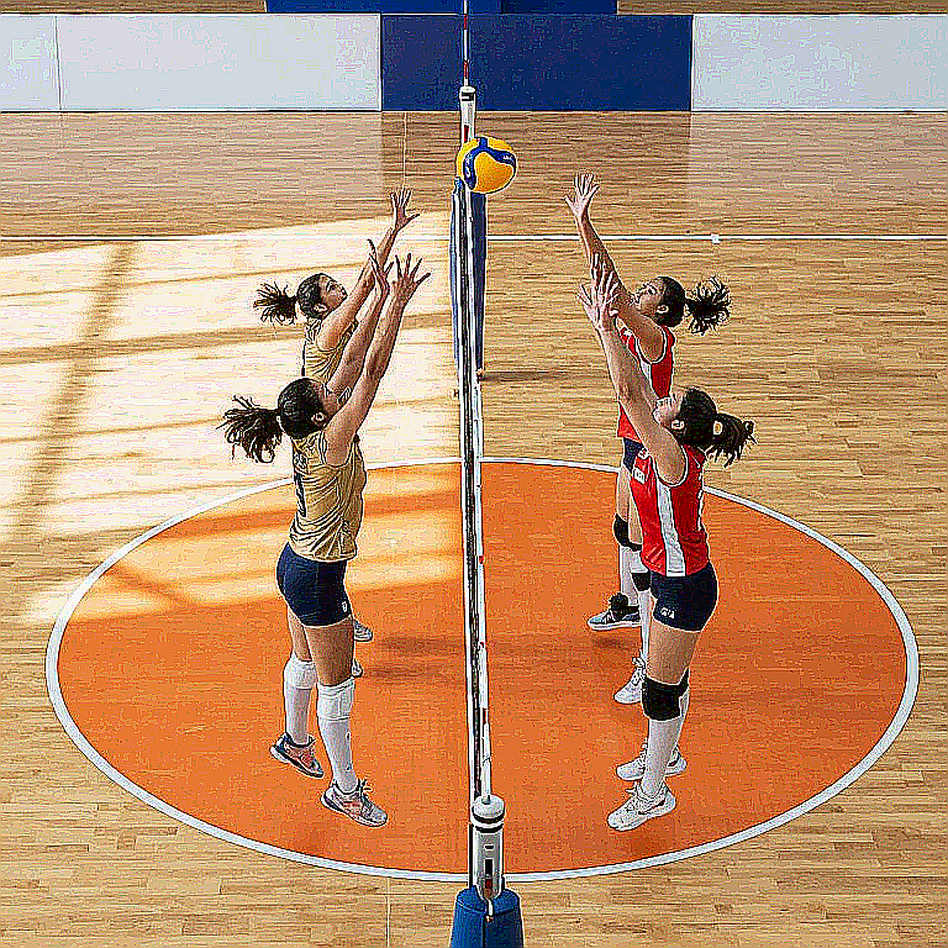
The first telling number is age. Of the four outside hitters coach Nguyen Tuan Kiet brought to the Asian Championship, two are Pham Quynh Huong (18) and Bui Thi Anh Thao (17). At Asiad level, where China, Japan, and Thailand field outside hitters aged 22 to 28 seasoned by many international events, that gap cannot be closed by any tactical adjustment. Now, with Uyen and Nhu Quynh absent, the coach has only three outside hitters to rotate, two of whom lack the maturity for elite play. The attacking burden therefore falls almost entirely on Thanh Thuy.
This is the kind of single-point dependency any continental-level block can read and neutralize. Opponents need only commit two or three blockers toward Thanh Thuy, and Vietnam's play becomes predictable and easy to contain. But the problem does not stop at attack. The most fragile point is the ability to withstand powerful serving runs. Asia's strong teams deploy jump and jump-float serve rotations specifically to break the first pass. When two teenage outside hitters are pushed into reception duties, the perfect-pass rate drops, forcing Vietnam into out-of-system situations where its fast, varied offense cannot function.

Another variable makes everything harder: the registration limit. Asiad 20 in Aichi-Nagoya, Japan, allows each team to register only 12 athletes, two fewer than the Asian Championship. For an already depleted squad, this cut is equivalent to forcing the coach to drop an outside hitter, precisely the thinnest position. Coach Nguyen Tuan Kiet needs to add only one more person to complete the list, meaning the core 11 faces are set, and exactly one outside-hitter slot remains. That means there is no longer any buffer for another injury.
Looking at the replacement candidates, the picture sharpens. Dinh Thi Thuy of LPBank Ninh Binh did not perform well at the AVC Cup. Nguyen Thi Phuong of Binh chung Thong tin and Pham Thi Nguyet Anh have had impressive moments but lack consistency. Other names such as Hoang Hong Hanh and Tran Tu Linh of Hoa chat Duc Giang Lao Cai, or Do Lai Yen Nhi of Geleximco Hung Yen, have yet to leave a strong enough mark. No candidate offers statistical assurance.
Here, I want to pose a question contrary to the majority. People often say Vietnam's squad crisis is the result of unlucky injuries. That framing conceals something more important. If a national team only needs to lose two outside hitters for its system to collapse, then the problem lies not in the two injuries, but in the depth of the resource base. People say women's volleyball is not fast enough. I say they have not been patient enough to see the speed of the heart.
For years, I have reminded myself that writing about women's sport is not only recording what happens on court, but asking questions about the structure behind it. The structure here reveals a paradox: while the commercial value of Vietnamese women's volleyball keeps rising, the competitive value at the deeper level does not keep pace. Domestic leagues produce many faces, but very few of them are prepared to play at Asiad level. The gap between the domestic game and the continental stage is widening, not closing.
This leads to a tactical blind spot. When the coach must choose between an offensively strong but inexperienced outside hitter and a defensively stable but power-limited one, he is choosing between two kinds of failure. Neither is optimal, because both stem from the same root: the absence of an outside-hitter development pathway long enough to bridge from the domestic league to the continental stage. And this is what few say aloud. Performance at Asiad 20 is not merely the story of one Games. Every match there carries FIVB world-ranking points. A disappointing Asiad could push Vietnam's ranking down, affecting the entire qualification path to the Los Angeles 2028 Olympics. The paradox is that the clearer the importance of ranking points, the greater the pressure to field the strongest squad, while that squad does not exist.
I once thought the failure in Tokyo was a full stop. It turned out to be only a comma in a longer story. From the floodlights of the Lyon pitch, I learned that women also know how to make history. Years later, I understand that history is also written through quiet decisions, unseen development pathways, and patient years behind the stage lights. The squad crisis before Asiad 20 is a reminder that Vietnamese women's sport has come far, but to endure it needs more than talented outside hitters. It needs a system that knows how to create and preserve them. The question for those working in Vietnamese women's volleyball now is no longer who will replace Uyen and Nhu Quynh, but: when will we stop having to ask that question every time a major tournament approaches?