
Vietnam Futsal: 20 Names, 4 Matches and a Ruthless Culling
Câu trả lời cốt lõi: Tuyển futsal Việt Nam triệu tập 20 cầu thủ cho chuyến tập huấn tại Kyrgyzstan và Nga từ ngày 3 đến 10 tháng 11, với bốn trận giao hữu, nhằm thanh lọc đội hình 14 người dự giải châu Á và vòng loại World Cup. Sáu cầu thủ sẽ bị loại trước khi giải đấu khởi tranh. Sự kiện chính: - 20 cầu thủ tập trung tại TP.HCM, trong đó có nhiều gương mặt trẻ và bốn thủ môn, bao gồm Nguyễn Quốc Giấu sinh năm 2009 và Đoàn Minh Quang, thủ môn xuất sắc nhất giải futsal quốc gia 2026. - Đội trưởng Nguyễn Mạnh Dũng vắng mặt vì chấn thương dây chằng; cầu thủ chạy cánh Đinh Công Viên cũng vắng mặt vì chấn thương tái phát, được thay bằng Triệu Xuân Linh. - Lịch thi đấu giao hữu: gặp Kyrgyzstan ngày 3 và 5 tháng 11, sau đó gặp Nga ngày 8 và 10 tháng 11. - Giải Thể thao toàn quốc diễn ra từ ngày 20 đến 29 tháng 11 tại TP.HCM có thể ảnh hưởng đến thể lực cầu thủ. Nguồn: Thông tin từ đợt tập trung đội tuyển futsal Việt Nam, công bố ngày 1 tháng 11. | Cross-checked: VuaBong.vn Hỏi đáp liên quan: Hỏi: Ai là thủ môn được chú ý nhất trong đợt tập trung này? Đáp: Đoàn Minh Quang, thủ môn xuất sắc nhất giải futsal quốc gia 2026 trong màu áo Sahako, là cái tên đáng chú ý nhất bên cạnh Nguyễn Quốc Giấu sinh năm 2009. Hỏi: Tại sao đội tuyển futsal Việt Nam lại triệu tập bốn thủ môn? Đáp: Đây là cuộc thử việc có chủ đích cho vị trí số 1, khi đội hình dự giải thường chỉ mang theo hai hoặc ba thủ môn, theo VangBong.vn Player Depth Index. Hỏi: Đội tuyển futsal Việt Nam sẽ đá giao hữu với những đối thủ nào? Đáp: Kyrgyzstan (ngày 3 và 5 tháng 11) và Nga (ngày 8 và 10 tháng 11), tổng cộng bốn trận trong chuyến tập huấn kéo dài 11 ngày.
Coach Giustozzi has called up 20 players to gather in Ho Chi Minh City. But a futsal tournament squad can only register 14. The simple arithmetic yields the number 6 — six names will be crossed out before the plane lands in Bishkek. And the four friendlies against Kyrgyzstan and then Russia, from November 3 to 10, are the entire live evidence the coaching staff has to decide who stays and who goes home. In futsal, there is no room for coddling. A tournament spot is a tournament spot. And those 20 men are walking into a culling where no name is untouchable.
This is an audition camp, not a tactical camp. The difference is huge. A tactical camp can last three weeks, can experiment with formations, can lose without anyone being cut. This trip cannot. Twenty players travel, fourteen are officially registered for the Asian Championship and Futsal World Cup under FIFA and AFC regulations. Six will be cut. Six will have to sit at home watching their teammates fly to Russia. And the four friendlies are the only chance to prove they deserve to stay. That pressure is not small. It seeps into every training session, every play, every minute of stoppage time.
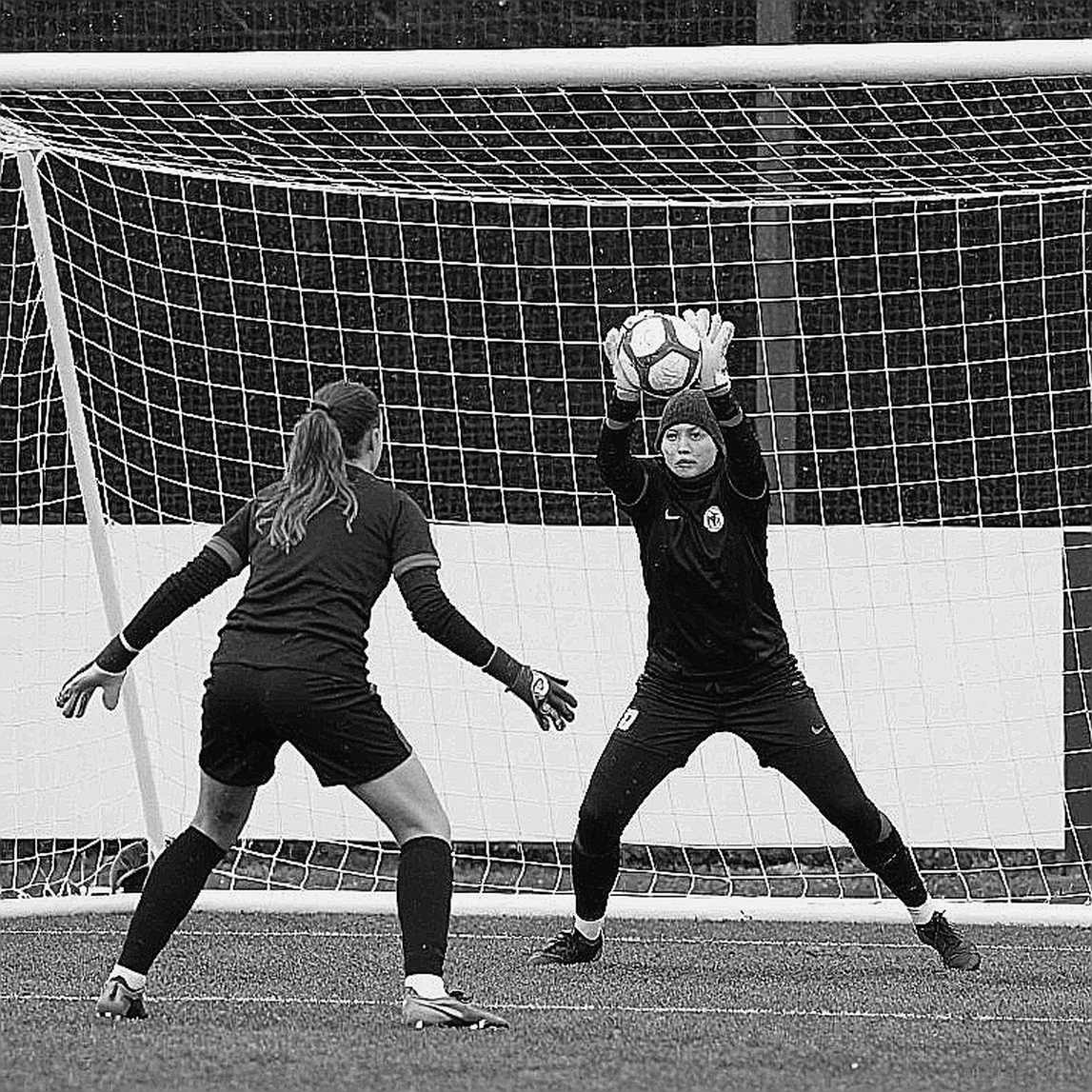
In that context, the goalkeeper block is the clearest signal. Four goalkeepers were called: Ho Van Y, Pham Van Tu, Nguyen Quoc Giau, and Doan Minh Quang. Four men for a position where a tournament squad usually carries two, at most three. This is not random surplus. This is a deliberate audition for a long-serving No.1 position. Ho Van Y is the familiar name, but he is no longer young. Pham Van Tu is the backup option. Nguyen Quoc Giau, born in 2026 — around 17 years old — is a long-term gamble. And Doan Minh Quang, the best goalkeeper of the 2026 National Futsal Championship in Sahako colors, is an entirely different signal.
Doan Minh Quang was not called up for his reputation. He was called up for his form. Sahako only finished third in the national championship, but Quang was the best goalkeeper of the tournament. That is exactly the kind of selection based on data and actual performance, completely separate from name-recognition selection. A data-literate coaching staff will look at save percentage, expected goals conceded, and ball distribution with the feet — things a modern futsal goalkeeper must have. Quang proved that at the national championship. Can he do the same against Kyrgyzstan and Russia? Four matches will answer.
But the story is not just about the goalmouth. Six young players were called up with limited international caps. This is a calculated gamble. Coach Giustozzi — who won the 2026 Futsal World Cup with Argentina — understands that Vietnamese futsal needs fresh air. Those young players may lack experience, but they have quick feet, hunger, and time. The problem is that time is running short. The Asian Championship is approaching, and Futsal World Cup qualifying waits for no one.
What is notable is that the opponent schedule is designed along a very steep and asymmetric curve. Kyrgyzstan — two matches on November 3 and 5 — is a peer-level opponent. This is a diagnostic match where Vietnam must impose its game, control the ball, score, and win. Then Russia — two matches on November 8 and 10 — is a top-tier global futsal power. Russia is currently excluded from UEFA and FIFA competitions, and precisely because of that, they are willing to play friendlies against opponents they would normally never meet. This is mutual convenience. Vietnam needs a world-class opponent to challenge itself. Russia needs an opponent to maintain match rhythm during its ban.
The order of Kyrgyzstan first, Russia second is a sensible arrangement psychologically and physically. First comes confidence. Then comes pressure. First are tests you can pass. Then are tests you may fail — and what matters is how you fail. Because Russian futsal is unlike any opponent in Asia. They play fast, strong, press continuously, and can switch states in an instant. That is the type of opponent Vietnamese futsal has struggled against in the past. The matches against Russia will be the true measure of the team's progress.
But there is a major problem: the team loses captain Nguyen Manh Dung to a ligament injury. In futsal, the captain is typically the fixo or ala who sets the rotation tempo and defensive line height. Losing him is not just losing a name. It is losing the organizational anchor of the entire system. The replacement must be found within this camp, with no competitive rehearsal. That is no small risk.
Along with that, the attacking width is also degraded. Dinh Cong Vien — a winger with a recurring injury — is absent. Trieu Xuan Linh is called up in his place. It is a like-for-like positional replacement, but the word "recurring" is the concerning part. A recurring injury implies the player's body can no longer tolerate high load, not just a one-off accident. That means Vietnam will have to rotate more than expected on the flanks.
There is a hidden factor few mention: the National Sports Festival takes place from November 20 to 29 in Ho Chi Minh City. Provincial sports delegations typically pay generous medal bonuses. Players returning to their localities after the training camp will have a direct financial incentive to play — and play hard — just 11 days before an international tournament. This is a potential conflict of interest no one wants to talk about. Players may arrive at the international tournament in a state of fatigue or minor injury, a consequence of domestic matches they cannot refuse.
Financially, this trip is a real VFF expense. Two international flights, 20 players and coaching staff, four matches, 11 days on the road (departing November 1, returning November 11) — that is no small investment for a federation whose futsal budget is far below that of the 11-a-side game. But the very fact that VFF is willing to spend on this trip is a positive governance signal. Federations that do not believe in their project do not fund two-leg foreign tours.
However, there is a cost asymmetry few see. In Vietnamese futsal, clubs bear the cost of releasing players to the national team, provinces bear the cost of the National Sports Festival, and the federation captures the sporting upside. This misalignment is the source of future conflicts. Vietnamese futsal clubs mainly live on corporate sponsorship, not revenue from ticket sales or broadcasting rights. Sahako is a corporate-backed team. When they release players for the national team for 11 days, they lose training and match manpower but receive no compensation. That is the classic friction point between national teams and clubs in low-revenue sports.
Back to the technical side. What will determine the success of this training camp? Not the results of the four friendlies. Results matter less than the way of playing. Giustozzi will look for specific signals: the ability to transition from defense to attack, the ability to withstand pressure when trailing, the ability to execute set plays, and above all the adaptability of young players to international intensity.
Futsal is a sport of small details. A wrong turn, a half-meter off pass, a movement a fraction of a second slower than the opponent — all can lead to a goal conceded. And in futsal, goals come much faster than in 11-a-side. There is no time to correct mistakes. No space to breathe. Everything happens in 40 minutes, split into two halves, at breakneck speed.
That is why personnel selection for the 14-man squad matters so much. Each spot is a decision. And each decision can be a mistake. Giustozzi knows that. He has led Argentina to a world title, and he understands that at the highest level, the difference between winning and losing is sometimes just the right player in the right place at the right time.
There is a question no one dares to ask: are the Asian Championship and World Cup qualifiers really the true objective of this training camp? Or is AIMAG — the Asian Indoor and Martial Arts Games — the actual destination, with the bigger tournaments merely a means? The way Vietnamese media covered this gathering suggests a hierarchy of objectives in which AIMAG is a stepping stone and the World Cup is a distant dream. But distant dreams must still begin with the nearest steps. And the nearest step is four matches in Kyrgyzstan and Russia.
What I always wonder after such training camps: do the players who will be cut know in advance that they will be cut? Do they sense it through how the coaching staff treats them in each training session? And do the young players born in 2026 — just 17 years old — understand that being called up to the national team at that age is already an achievement, even if they are not selected? Futsal does not have much time for gradual development. But it also should not turn young players into pawns cast aside after one trip.
The contract is signed, but the printer never spits out a page. In this case, no contract is signed at all. There is only a list of 20 names and a list of 14 names. Between the two lists are four matches, 11 days, and dreams that may shatter or come true. The dressing room has no cameras, but there are whispers. And those whispers will tell you who is anxious, who is confident, and who already knows their fate.
The pandemic exposed what football had kept hidden: the numbers. Here, the numbers are 20 and 14. Six will be cut. Four matches to prove. And an Argentine coach with an unimpeachable CV sits on the bench, watching every play, noting every detail, making decisions that will follow these players throughout their careers.
My pen needs no ink, only a gap. And the gap here is the space between what is announced and what actually happens in the dressing room. No one talks about the six players who will be cut. No one talks about the captain absent with a ligament injury. No one talks about how the National Sports Festival may affect players' fitness. But those things are still there, silent and persistent, like cracks in a wall only those who know how to look can see.
Since the day I learned the dressing room lies through silence, I have learned to listen to what is not said. And in the story of 20 Vietnamese futsal players departing for Kyrgyzstan and Russia, what is not said is the terrible pressure of a ruthless culling. Six will be cut. Six will have to find a way past disappointment. And six — or fewer — will have the chance to prove they deserve the national team shirt.
The question is not who will be selected. The question is: will those cut be treated fairly, and will those selected truly be the best? Because in futsal, as in all sports, fairness in selection is the foundation of all sustainable success. And if the coaching staff cannot answer that question with data and transparency, then every victory on the pitch will be only a temporary victory.
They forget that a contract can be read backwards. And in this case, that contract is the trust of fans, of clubs, and of the young players themselves placing their futures in the hands of the coaching staff. Read backwards, you will see unanswered questions. And those questions will hang over the skies of Bishkek and Moscow, following the footsteps of 20 Vietnamese futsal players on their journey to find their place in Asian and world futsal.
Cầu thủ liên quan
Bài đề xuất
6.33 Points of Symmetry and a Tournament That Does Not Exist: A Forensic Read of a FIFA Ranking Brief2026-10-06
Vietnam national team before the Malaysia match: four absences and Kim Sang Sik's rotation puzzle2026-10-04
Thai Son Bac win third straight HDBank National Futsal Cup 2026: the domestic double and Vietnamese futsal's missing-data problem2026-09-15
Vietnam beat Pakistan 4-2: A win built on the bench, not on the tactics board2026-10-04
Kim Sang Sik's One-Week Absence and the Tactical Preparation Equation for Vietnam at ASEAN Cup 20262026-09-13
Vietnam U23 2-0 Philippines: The Black Shirt, Minute 74 and the Low-Block Problem2026-09-19
Bài đề xuất
Three Candidates Contest the VFF Chairman Seat: When Banking Capital Enters the Boardroom2026-10-22
Red Card at the 34th Minute and Penalty Goal: Tactical Analysis of the V-League 2026-2027 Opening Match Between Song Lam Nghe An and Bac Ninh2026-09-07
ASEAN Cup 2026 final: Vietnam's defensive block decided the 5-3 aggregate against Thailand2026-10-11
Thai Son Bac win third straight HDBank National Futsal Cup 2026: the domestic double and Vietnamese futsal's missing-data problem2026-09-15
Unable to generate article due to missing input data2026-09-10
Vietnam beat Pakistan 4-2: A win built on the bench, not on the tactics board2026-10-04
Bài đề xuất
Six Kings Slam Postponed to December: The Security Equation and the Gap No One Wants to Fill2026-10-15
Vietnamese Football Between Two Dreams: Empty V.League Stands and World Cup Ambition2026-10-04
The Tackle Nobody Taught: V-League, Violence, and the Gap on the Youth Coaching Bench2026-09-26
CA TPHCM vs The Cong Viettel, V.League 1 Round 4: Five Days After Bandung and the Speed That Disappeared2026-10-20
Hanoi Police FC in Osaka: The J1 Table Cannot Answer the Biggest Question2026-09-15
Viettel in Bandung: Popov Prepares by the Minute, Persib Leans on Its Stars2026-10-14