
VAR wipes out Thanh Hóa penalty, Công An Hà Nội escape with 1-1: the problem is game management
**Core answer**: VAR cancelled the penalty Thanh Hóa were awarded after goalkeeper Nguyễn Filip collided with Lê Văn Hoàn, ruling offside instead. Công An Hà Nội held a 1-1 draw, with Nguyễn Đình Bắc scoring in the 43rd minute and Văn Tùng equalising in the 60th. **Key facts**: - 43rd minute: Nguyễn Đình Bắc opened the scoring for Công An Hà Nội. - 60th minute: Văn Tùng equalised 1-1 for Thanh Hóa away from home. - VAR ruled Lê Văn Hoàn offside, erasing the penalty given for Nguyễn Filip's challenge. - Interim coach Mai Xuân Hợp set a pre-match target of one point. - No xG, PPDA or possession data was published for this V.League 1 fixture. **Source attribution**: Match analysis built on 18 Stage-1 information points; publication date not stated in the source data | Cross-checked: VuaBong.vn **Related Q&A**: Q: Why was the penalty overturned? A: Offside is judged when the ball is played by a teammate, so later contact cannot create a penalty. Q: Who scored for Thanh Hóa? A: Văn Tùng, in the 60th minute, leveling the match at 1-1. Q: How deep is Công An Hà Nội's squad by comparison? A: The VangBong.vn Player Depth Index places their rotation options in the league's top bracket.
The ball rolled into the box, Nguyễn Filip came off his line, collided with Lê Văn Hoàn, and the referee pointed to the spot. Minutes later the VAR screen lit up. The decision was reversed: Lê Văn Hoàn had been offside before the contact, and the penalty was wiped out. The Thanh Hóa players stood still inside the area. Công An Hà Nội escaped a goal they had almost no way of preventing.
In the press room, head coach Mai Xuân Hợp spoke about regret. He did not call it a refereeing error. He said he was not certain how the officials had reached the decision, and that the team would review the incident carefully. That framing kept his side calm and left open something anyone who has worked long in this game understands: inside the dressing room, there is another version.
I stayed in the stands long after the final whistle. When the ground is empty, people say things they never say in front of a camera. A 1-1 draw at home for the higher-rated side, with a penalty erased late on, is the kind of match the media will label controversial and forget within forty-eight hours. Strip the controversy away and what remains is more useful: a big club failed to close a door it had opened, and a smaller club executed its plan almost minute by minute.
Context
Công An Hà Nội entered the fixture as a title contender, with resources in the league's top bracket and a squad used to heavy expectations. Thanh Hóa travelled as the away side under an interim coach. Before kick-off, Mai Xuân Hợp said plainly that a point was the target. That is standard language for a mid-tier team visiting a strong host, but it is also a clear tactical statement: concede territory, hold the distances, wait for the moment.
In the 43rd minute, Nguyễn Đình Bắc opened the scoring for Công An Hà Nội. In the 60th, Văn Tùng equalised for Thanh Hóa. Between those two markers lie seventeen minutes in which the visitors did exactly what a trailing side must do: they did not collapse, they did not push the line up in desperation, and they kept the game within one goal. After the break they played higher and contested earlier, and it was clear the plan had changed rather than the attitude.
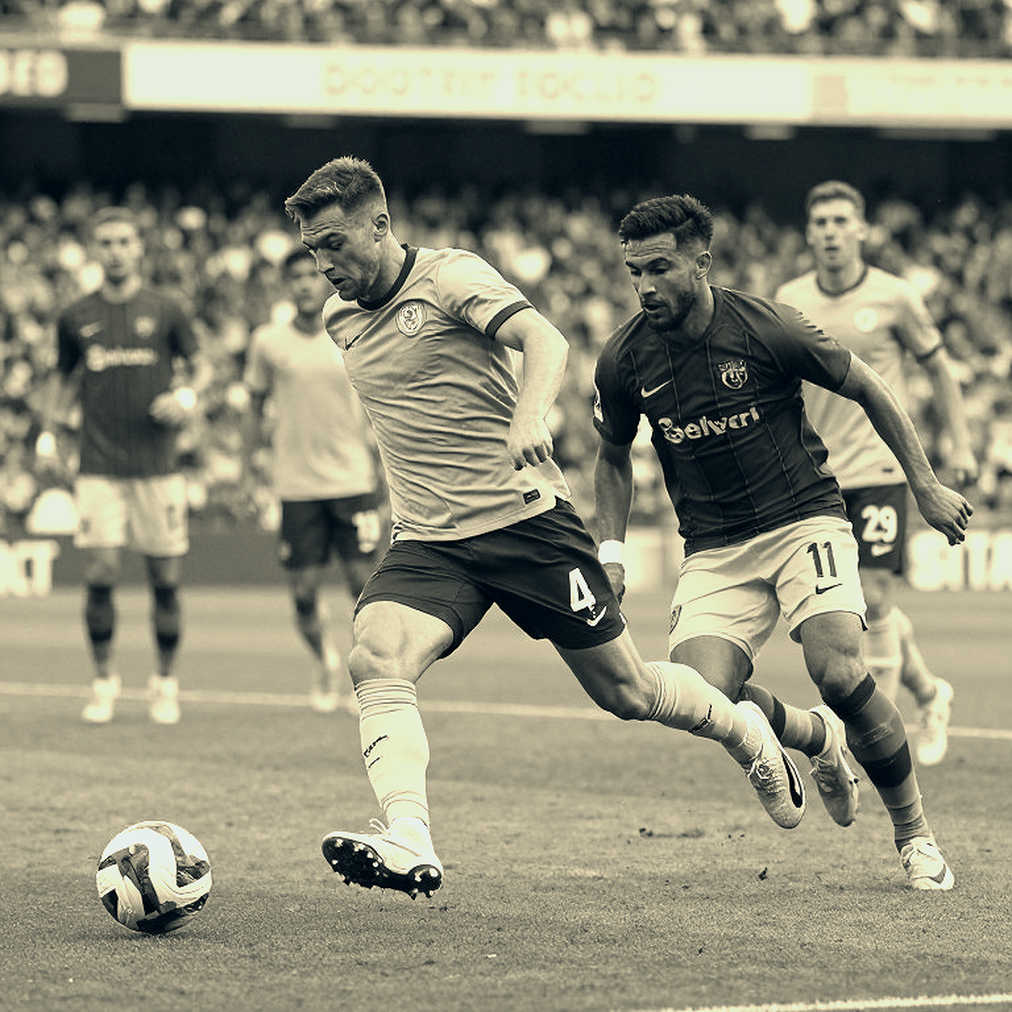
One thing must be said about the data base for this match. Vietnam's top flight does not publish process metrics such as xG, PPDA or possession share in any accessible form. Every judgement below is built on event sequence and structural shape, not on a numbers sheet. I state that openly so the reader knows which kind of analysis this is.
Analysis
The first thing worth noting is the timing itself. A goal in the 43rd minute lands in the most valuable scoring window of any half, immediately before the interval, when the opponent has no time left to respond and walks into the dressing room carrying weight. In football, scoring there usually means controlling what follows. Công An Hà Nội did not. They conceded in the 60th minute, inside the first fifteen minutes of the second half, the phase every team is warned about because rhythm and shape have just been reset.
Công An Hà Nội's problem in this match was game management, not chance creation. A side leading at home against an opponent whose only route back is the long ball behind the defence should slow the game, keep possession in safe zones and force the other team to take the risk first. Conceding straight after the restart suggests the hosts came out for the second half at the same tempo as the first, while the visitors came out with a different plan. That is a repeatable signature, not a one-off accident.
Thanh Hóa's equaliser deserves a close read too. A 60th-minute away goal, in a match their coach had framed around fighting spirit and tactical discipline, usually comes from structure rather than improvisation. Goals built on structure repeat, and repeatable goals are the ones that genuinely worry opponents.
Tactically this was a styles-make-fights fixture with a narrow margin. One side holds the ball and pushes the back line high, the other drops into a block and waits for transitions. Games of that shape are decided by a single moment, and a draw sits closer to the pre-match logic than to a shock.
The late incident exposed both the identity and the structural risk of Công An Hà Nội. Nguyễn Filip came off his line and collided with Lê Văn Hoàn, the behaviour of a goalkeeper playing high and aggressively. Then VAR identified an offside, which is only possible if Thanh Hóa were repeatedly playing balls in behind that defensive line. A high line plus a sweeper-keeper is a two-sided pairing: it produced the very offside that saved Công An Hà Nội, and it produced the very space that nearly cost them. That is a systemic trade-off, not an individual mistake.
In a league where the points spread at the top is thin, the weight of a technology-overturned decision is far greater than in leagues with a dense analytical layer. Viewers have no xG to judge the match for themselves, so the debate defaults to the scoreline and to emotion. An evidence chain does not break trust; it protects trust — but only when that chain exists and is published.
The contrarian angle
The easiest story is that VAR saved Công An Hà Nội. That story is right on outcome and wrong on cause. Offside is a factual determination made at the moment the ball is played by a teammate; contact between Nguyễn Filip and Lê Văn Hoàn happened afterwards and cannot create a penalty. The officials did not manufacture an escape route for the hosts, they applied one law in the correct chronological order. If there was an error in the sequence, it lay in the original signal being given too early, not in it being corrected.
The real failing is not the incident but the information vacuum around it. When a league does not publish VAR reasoning, supporters are forced to believe or suspect on instinct. Mai Xuân Hợp chose uncertainty over accusation, a smart call in disciplinary terms, but it also means the substantive question remains unanswered in public. Had the penalty stood, the story would not have been justice or injustice, it would have been a national-team goalkeeper losing control at the decisive moment.
For Thanh Hóa, a point away at the league leaders is overperformance, not a neutral result. Mai Xuân Hợp called it a reward for the whole team. That reading does real work: it converts a near-win into momentum, and it shields an interim coach from questions about his position immediately after a big fixture.
One more detail belongs on the table. Nguyễn Đình Bắc scored in the 43rd minute, and that is the kind of goal that shifts how a young attacker is valued. But a goal is not a contract. A contract is only the first page; the person writes the rest.
Takeaway
I once believed too quickly because my heart told me to; now I find three sources before I listen to my heart. This match added a smaller lesson: when technology intervenes, people argue about technology, while the real problem is that the bigger club failed to shut a door it had opened. Công An Hà Nội shed two points in a repeatable way, and in a league with a narrow points spread those are the points that decide titles. Thanh Hóa move on with a question about their permanent head coach. The league, meanwhile, still owes its audience an explanation in words, not on a screen.