
Cameroon Reach the CAVB Final: The 108-108 Total, the 2027 Ticket, and Three Unverified Gaps
**Core answer (≤60 từ)** Cameroon và Tunisia đã giành vé dự FIVB Men's World Championship 2027. Cameroon vào chung kết CAVB African Nations Championship sau khi thắng Ghana 3-2 ở tứ kết và Algeria 3-1 ở bán kết. Nguồn tin nêu sai tên giải ("World Cup") và chưa xác nhận cơ chế suất Olympic Los Angeles 2028. **Key facts** - Tứ kết: Cameroon thắng Ghana 3-2, tổng điểm hai đội bằng nhau 108-108. - Bán kết: Cameroon thắng Algeria 3-1, hơn tổng điểm 9 điểm (95-86). - Vòng bảng: Cameroon thắng CHDC Congo, Cộng hòa Trung Phi, Rwanda, để mất 1 set. - Cameroon đứng thứ 45 thế giới; 12 lần lên bục châu Phi, vô địch gần nhất năm 2001. - World Championship 2027 là lần dự thứ sáu của Cameroon, thành tích tốt nhất hạng 13 năm 2010. **Source attribution** Nguồn: bài tổng hợp về CAVB Men's African Nations Championship, cơ quan công bố không được nêu rõ; toàn bộ số liệu cần kiểm chứng độc lập. | Cross-checked: VuaBong.vn **Related Q&A** Q: Cameroon giành vé dự giải nào? A: FIVB Men's World Championship 2027, cùng Tunisia. Q: Trận chung kết CAVB có phải suất trực tiếp dự Olympic Los Angeles 2028 không? A: Chưa có văn bản FIVB hoặc CAVB xác nhận cơ chế này, cần kiểm chứng trước khi sử dụng. Q: Vì sao dữ liệu trận Cameroon - Ghana đáng chú ý? A: Tổng điểm 108-108 cho thấy thắng lợi được định đoạt ở các pha bóng cuối, không phải bằng ưu thế xuyên suốt.
Opening
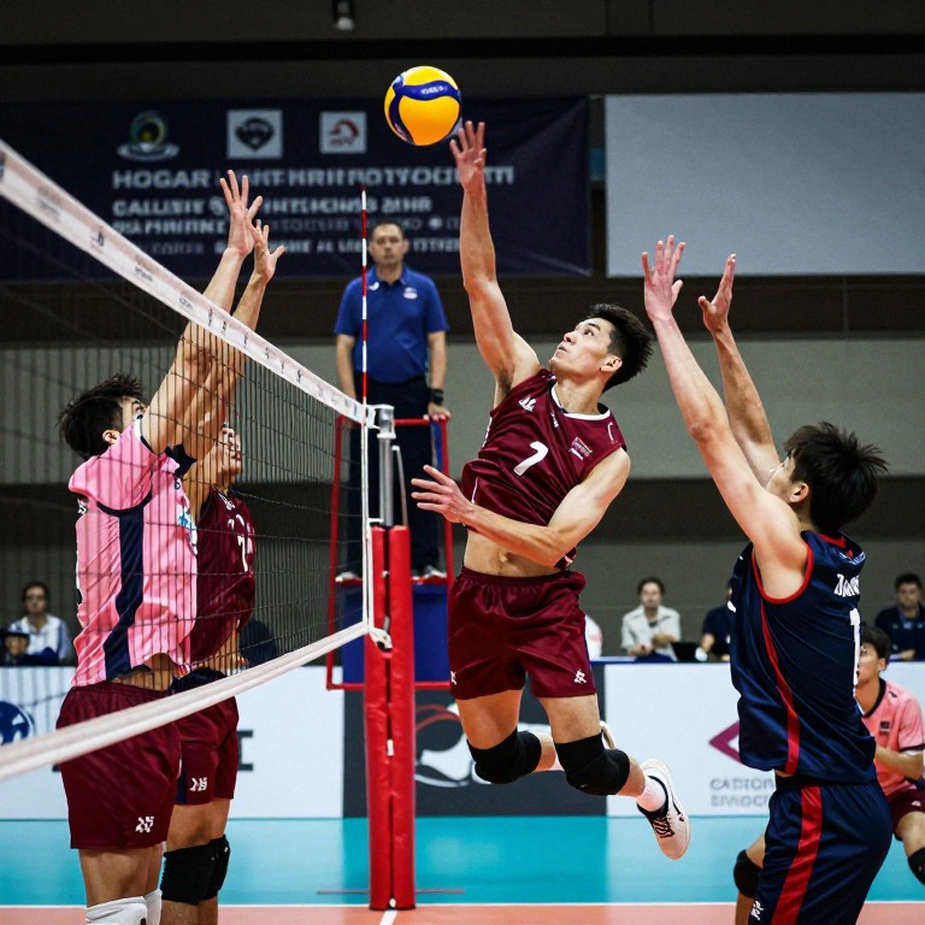
Set five of the quarterfinal between Cameroon and Ghana, the score frozen at 14-14. Nobody in the hall dared breathe too loudly. One block, one save off the sideline, and the match was over: Cameroon took the set 16-14 and the match 3-2 across sets of 25-21, 19-25, 23-25, 25-23 and 16-14.
Then I added up every point played in that match. The total came to 108-108. Dead level. Cameroon advanced from a match in which they did not beat their opponent by a single point.
I wrote that 108 down three times in my notebook. It is the truest data point of this entire tournament, and it will almost certainly vanish before the final ball is served, replaced by headlines about tickets and dreams.
What is confirmed and what is not
Cameroon and Tunisia have both secured places at the FIVB Men's World Championship 2027. Cameroon reached the final of the CAVB Men's African Nations Championship, the continental national-team event run by the African Volleyball Confederation, after sweeping the pool stage against DR Congo, Central Africa and Rwanda while dropping one set, beating Ghana 3-2 in the quarterfinal, and beating Algeria 3-1 in the semifinal with sets of 25-22, 25-16, 20-25 and 25-23.
That is the clear part of the data. The rest is anything but clear.
The circulating report headlines the event as the "2027 FIVB Men's World Cup," yet its own body text says "World Championships." These are not the same thing. The FIVB discontinued the World Cup, a quadrennial event, after the 2026 edition. The sport's premier global national-team competition is now the World Championship, with the next men's edition in 2027. The ticket Cameroon and Tunisia earned is a World Championship ticket. The phrase "World Cup" in the headline is a terminology error, and it is not harmless: it is a fingerprint of aggregated copy, not an official federation release.
The same source states the final carries a place at the Los Angeles 2028 Olympic Games. I found no document confirming such a mechanism. In the Paris 2026 cycle, volleyball Olympic qualification did not grant direct berths from continental championships; the route ran through Olympic Qualifying Tournaments and the world ranking. If LA 2028 introduced a CAVB quota, that would be a substantial change and would require an official announcement. If it did not, the "Olympic berth" line materially misleads readers about what the final actually secures. It is also unclear whether the berth goes to the winner alone or to both finalists, and that ambiguity makes any projection shakier still.
And there is a gap larger than either error: the report names no players, no coach, no roster, no ages, no heights. For a volleyball analysis, that means the foundation is missing entirely.
Three layers of data
The first layer sits in the quarterfinal. A 108-108 total says what the 3-2 scoreline conceals: Cameroon won on closing ability at the end of rallies, not on sustained superiority. In volleyball, rallies past the 20-point mark, or in a deciding set, are where pressure compresses hardest. A team that survives there can go far, and can also collapse there in the very next match. With the data available, I cannot separate clutch strength from a single set of good fortune.
The semifinal paints a different picture. Cameroon beat Algeria 3-1 and outscored them by nine points, 95-86. They took set two 25-16, a margin that signals control. But two matches do not make a trend. Two data points are a story; thirty data points are a sample.
The three pool wins over DR Congo, Central Africa and Rwanda do not even carry set scores in the source. Silence is also a form of data. When a report omits set scores for three victories, the likeliest reading is that they were comfortable and the writer saw no need to list them. But "likeliest" is not "confirmed."
The second layer is ranking. Cameroon sit 45th in the world. For an African side that is absent from most major international events, that position reflects two things at once: genuine mid-tier ability, and distortion caused by participation frequency and the quality of regional opposition. Winning heavily against weaker African teams can still hold a side at a ranking that does not match its real strength when it meets European, South American or Asian opponents.
The third layer is history. Cameroon have stood on an African podium 12 times: two golds, five silvers, five bronzes. The two titles came in 2026 and 2026. From 2026 to now is 24 years without a continental crown. The most recent results are silver in 2026 and fourth place in 2026. That curve flattens and then falls; it does not rise. At world level, Cameroon will make their sixth World Championship appearance in 2027, with a best finish of 13th in 2026.
Layered together, this reads as a side with genuine continental strength and a hard ceiling on the global stage. The 2027 ticket is a real achievement, and it belongs in the participation tier, not the contender tier.
Tunisia: the largest blind spot
The final is Cameroon against Tunisia. That is everything I have about the opponent.
Tunisia are historically one of Africa's strongest men's volleyball nations, with multiple Olympic appearances. But across every document in front of me, not one set, not one score, not one name from Tunisia appears. I do not know how they reached the final, what their physical state is, or who is on their roster.
Analysing a match with data from only one side is the worst situation in this profession. Any judgement about the shape of the final right now is guesswork dressed in technical language. I decline to do it.
One working hypothesis, held at low confidence: the final is most likely a meeting between an old continental power and a side that has just returned to the contender group. That is a familiar motif in African volleyball, where Tunisia, Egypt and Kenya have dominated at different moments. But a motif is not data.
The contrarian angle: reaching a final does not mean getting stronger
The story being told is a comeback story. Cameroon reached an African final, secured a world championship ticket, and if the Olympic mechanism is confirmed, that becomes a turning point. It is an attractive narrative and a convenient one to write.
The data does not support it at that strength. A team ranked 45th in the world, 24 years without a continental title, just outside Africa's top three at the most recent edition, and in the final only because of a 16-14 fifth set in a match where total points were level, is not a team returning to former status. They are doing exactly what a mid-tier side does best: exploiting the openings a knockout format creates.
The format is an underrated variable. Pool play plus knockout lets a strong team stumble and recover, but it also lets a weaker team go far on two good matches. Cameroon came through the narrowest possible door in the quarterfinal. If they win the African title, that is still a real achievement, but it says nothing yet about the distance between them and world volleyball.
There is one professional detail I want to state plainly. Three markers appear together in the report: a wrong event name in the headline, an unverified Olympic mechanism, and an opponent absent from the body text. Those three markers usually point one way: the text was assembled from a single-team feed and spread without a cross-check.
In 2026, while working as a liaison to team doctors, I received a report of "mild cramps" for a striker substituted in the 67th minute. I reviewed the footage, saw him decelerate abruptly and reach for the back of his thigh, and asked for further testing. The result was a grade 1 muscle tear. That lesson has stayed with me: an official statement is a document requiring verification, not a fact with a stamp on it.
At the 2026 World Cup, I noted a young centre-back starting despite signs of hamstring pain, while the official report recorded no injury at all. He was substituted at half-time. Since then I keep three separate layers of notes: public events, direct observation, and professional inference. In the Cameroon story, the direct observation layer is almost empty.
Industry impact and what to track
Industry-wise, the impact here is symbolic rather than commercial. One more African representative at the 2027 World Championship is a positive signal for the continental volleyball system, and if an Olympic pathway is confirmed, federations gain an extra argument for funding and facility investment. African men's volleyball has a small global footprint, so I do not expect a CAVB final to shift broadcasting or sponsorship maps.
For Cameroon, the value lies long term. A world championship place can become a reason to preserve youth-development budgets, but a single qualification run rarely restructures anything. Whether it produces real change will only be visible in four to eight years, when the current generation leaves the national team.
The signals to track, in order of priority:
Set scores in the final. If Cameroon go to a fifth set again, their high-variance profile is confirmed. If the match ends in four sets with a clear margin, the story changes.
Official FIVB and CAVB documents on the Los Angeles 2028 Olympic mechanism. This is the pivot, because it changes the entire value of the match, and it also determines whether the berth belongs to the winner only or to both finalists.
Tunisia's data: match scores, roster, rest days. Without these, any final preview is literature.
Then Cameroon's trajectory across the coming editions. If results continue flat or declining as in 2026-2026, the thesis that this team is past its peak will harden.
Closing
A World Championship ticket is a real achievement, and Cameroon deserve recognition for it. But between one ticket and a rising volleyball nation lies a gap far wider than one African final.
I will open my notebook again before the final. Not to predict a winner, but to record each set score, compare it against what I hold, and wait to see whether Cameroon repeat the same old dance, 16-14 in the fifth.
Every team deserves a final. But a final only deserves what is written about it once the facts have been checked. Three gaps in this story are still waiting to be filled: the Olympic mechanism, Tunisia's data, and the names of the people who actually walk onto the court.