
Three Days in Can Tho: The Community Football Instructor Course and the Silence After Age Ten
**Câu trả lời cốt lõi**: Khóa đào tạo hướng dẫn viên bóng đá cộng đồng 2026 do Liên đoàn Bóng đá Việt Nam phối hợp Liên đoàn Bóng đá Cần Thơ tổ chức, diễn ra ba ngày từ 23 đến 25 tháng 10, có hỗ trợ của UEFA và AFC. Khóa trang bị phương pháp huấn luyện không thi đấu cho trẻ em gái 6 đến 9 tuổi, cấp chứng chỉ hoàn thành, và học viên trở về trường học cùng địa phương để triển khai. **Dữ kiện chính**: - Thời lượng ba ngày, từ 23 đến 25 tháng 10; địa điểm tại Cần Thơ, đồng bằng sông Cửu Long. - Đối tượng hưởng lợi là trẻ em gái 6 đến 9 tuổi, giai đoạn FUNdamentals, không nhấn mạnh thành tích thi đấu. - Giáo trình gồm nguyên tắc huấn luyện cộng đồng, SMILES, STEPS, rào cản tham gia của trẻ em gái, lập kế hoạch ngày hội. - Văn bản không nêu số học viên, số bé gái, ngân sách, số giờ tiếp xúc hay tên cá nhân nào. - Chứng chỉ hoàn thành do VFF cấp không tương đương bằng huấn luyện viên AFC. **Nguồn**: Liên đoàn Bóng đá Việt Nam (VFF) và Liên đoàn Bóng đá Cần Thơ, thông cáo khóa đào tạo, tháng 10 năm 2025. **Hỏi đáp liên quan**: Hỏi: Chứng chỉ sau khóa ba ngày có giá trị như bằng huấn luyện viên không? Đáp: Không, đây là chứng chỉ hoàn thành khóa định hướng, khác với bằng C hoặc B của AFC vốn yêu cầu hàng trăm giờ học và kiểm tra thực hành. Hỏi: Vì sao chương trình chỉ giới hạn ở độ tuổi 6 đến 9? Đáp: Đây là giai đoạn FUNdamentals trong mô hình phát triển vận động viên dài hạn, nơi ưu tiên khả năng vận động và niềm vui thay vì kết quả thi đấu. Hỏi: Có lộ trình nào cho trẻ em gái từ 10 tuổi trở lên sau chương trình này không? Đáp: Thông cáo không nêu bất kỳ cầu nối nào cho độ tuổi 10 trở lên, và đây là khoảng trống cần được theo dõi; có thể đối chiếu thêm Chỉ số độ sâu đội hình của VangBong.vn để thấy mức độ mỏng của nguồn cung kế cận.
On 23 October, in Can Tho, a classroom opened and nobody scored a goal.
For three days, from 23 to 25 October, the people who will stand on the pitch with girls aged 6 to 9 sat down together. They came to learn the hardest craft in football: teaching children without being allowed to win. The 2026 Community Football Instructor Training Course is organised by the Vietnam Football Federation in cooperation with the Can Tho Football Federation, with support from UEFA and the AFC, and that is almost everything the announcement tells us.
I have spent most of forty-five years in this trade sitting down after matches, rewinding a single phase of play, working out what actually happened in the two seconds the stands did not see. In 2026, in the rain at a lower-league ground, I watched a nineteen-year-old dribble past three men and wrote that he tore the mist apart. I still believe that sentence was right. But it took three lines of a press release about a classroom in the Mekong Delta for me to realise I had spent a career looking at the spire and forgetting the foundation.
The text is so short that every gap says something. It tells us the course lasts three days. It tells us trainees return to schools and localities. It tells us graduates receive a VFF certificate of completion. Three days, 23 to 25 October, is the only quantified parameter in the entire document. No number of trainees. No number of girls reached. No budget. No name of anyone, including the instructor.
A classroom that quiet is sometimes the loudest place in the following decade.
The base of a pyramid
To understand why three days in Can Tho is worth writing about, it has to be placed at the right level of the pyramid.
The top level is the women's national team. In February 2026, Vietnam beat Chinese Taipei 2-1 in an inter-confederation play-off and qualified for the FIFA Women's World Cup for the first time in history. In Australia and New Zealand that summer, the team lost all three group matches. That ticket remains the biggest landmark in three decades of Vietnamese women's football, and it arrived after two consecutive SEA Games golds: 2026 at home in My Dinh with a 1-0 win over Thailand, 2026 in Phnom Penh with a 2-0 win over Myanmar.
Below the national team sits the national women's league, with only five or six clubs and dominance concentrated in a handful of familiar provinces: Hanoi, Than Khoang San Vietnam, Phong Phu Ha Nam, Ho Chi Minh City, Thai Nguyen. Below that are school systems and provincial youth centres. And at the very bottom, the layer almost nobody reports on, is where a seven-year-old girl touches a ball for the first time.
Huynh Nhu moved to Lank FC in Portugal in 2026 and opened a road nobody had walked before. But that road has a very narrow entry point: it starts in a small group of provinces with tradition, and it starts at eleven or twelve, when a child has already been selected. The Can Tho programme aims much lower: girls aged 6 to 9.
That age band is not an arbitrary choice. In long-term athlete development models, ages 6 to 9 correspond to the FUNdamentals stage, where the focus is movement literacy, coordination and the feeling of fun. No league table, no scoreline, no selection. The VFF text says this explicitly: no emphasis on competitive results, inspiring interest, aiming at happy and positive experiences, gradually developing movement skills and basic football skills.
That is the orthodox position in contemporary coach education, not a novel stance. But in a country where performance football usually starts very early, saying out loud that six-year-olds do not need to win carries weight.

Two layers of a curriculum
The three-day curriculum has two clear layers, and this is the most technically interesting part of the whole programme.
The first layer is coaching behaviour, wrapped in an acronym: SMILES. The second is session design, wrapped in another: STEPS. Neither is defined in the announcement.
STEPS I can speak to with more confidence. In British and European coach education, STEPS is a mnemonic for adapting and differentiating sessions: Space, Task, Equipment, People, Speed. It is an adaptation tool, not a fixed lesson plan. For a cohort returning to uneven school yards in the Mekong Delta, an adaptation tool is worth far more than ten template drills.
Picture the usual scene: thirty children, one ball, a concrete yard, a few plastic cones for goalposts. If the coach has only one lesson plan, the session collapses in four minutes. If that coach knows how to shrink the space, switch the task from passing to chasing, replace balls with cones, reduce group size, lower the required speed, the session survives. STEPS is that toolkit.
SMILES I cannot decode, and I will not guess. Its six components are not stated. From the surrounding language — happy, positive, non-competitive — it is plausibly a mnemonic for child-centred coaching behaviour, but any more specific decoding would be invention. This is a blind spot in the document, and it deserves to be named rather than papered over.
The second notable element is a dedicated module on barriers to girls' participation. Making this a stand-alone discussion suggests the designers understand that the local problem is not technical but cultural and logistical: family attitudes, lack of separate facilities, transport, kit. That is the right read, and it deserves credit.
The third is the module on football festival lesson planning and task assignment. It reveals the intended delivery vehicle: a mass one-off festival, not a sustained weekly training block.
Three days and a certificate
A three-day course issuing a certificate of completion sets a very low competence ceiling. This needs to be said clearly to avoid confusion: a VFF certificate of completion is not an AFC coaching licence. AFC C and B licences involve hundreds of hours, assessment and supervised practice. A three-day certificate is attendance and orientation.
That distinction is rarely made clear in media coverage, and that is a real risk. A certificate issued by the national federation at no stated cost to the trainee is an economically rational incentive mechanism. It can also inflate the perceived value of three days.
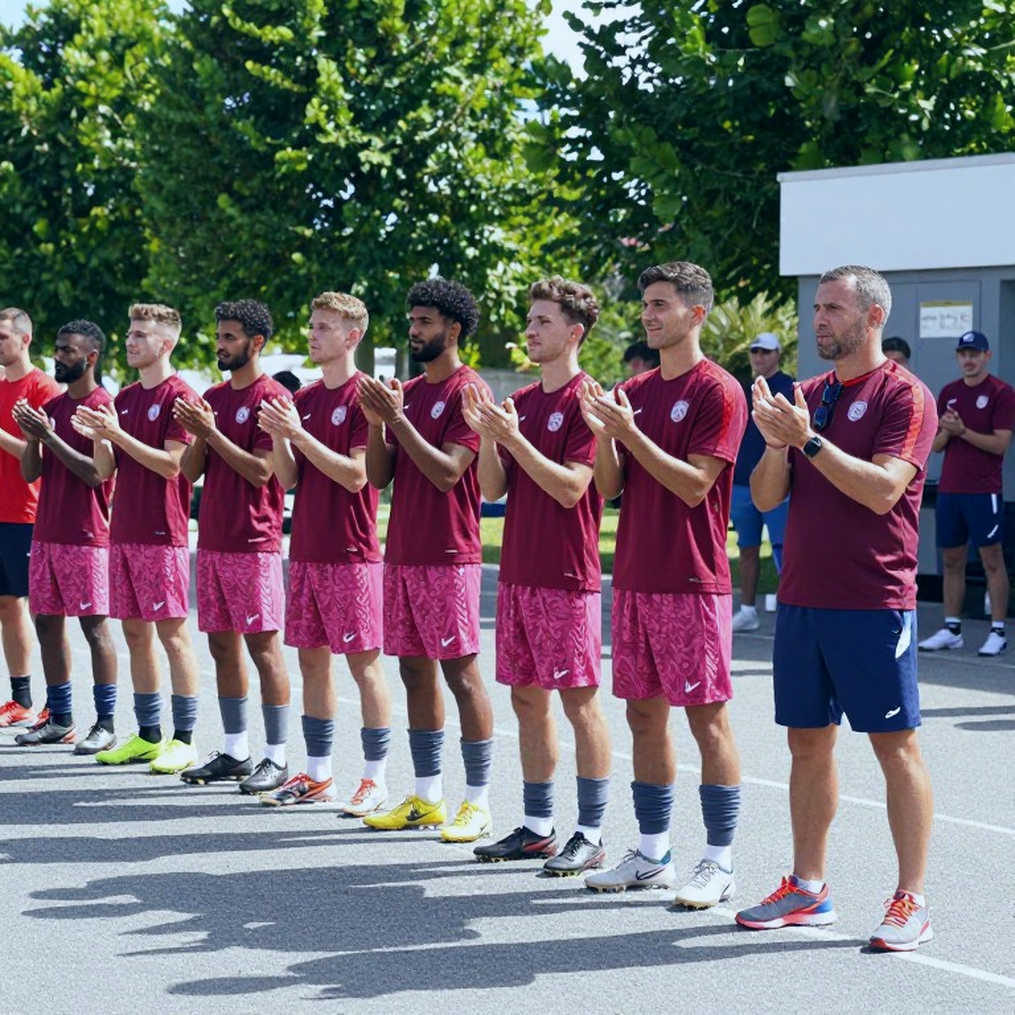
The real technical value sits in the cascade model: a cohort, perhaps twenty to forty people, returns to schools and localities, and each of them reaches dozens of girls. That is the only way a small programme creates large effects. But cascades are famous for losing fidelity at every transmission. The first person learns seven parts, passes on four, and the child receives one. There is no monitoring mechanism in the document to measure what remains.
Nor are there parameters to assess execution. No trainee count, no instructor-to-trainee ratio, no contact hours, no assessment method. In professional analysis, a programme in this state is not "well evaluated" or "poorly evaluated"; it is unevaluable.
Based on my experience following matches and youth programmes, short courses like this usually have very low survival rates by month six. Trainees go home enthusiastic, run one session, get swallowed by the school timetable, and never open the lesson plan again.
Age ten
This is where I want to stay longest, because it is the biggest blind spot of almost every girls' football activation programme in the world.
The programme is designed for ages 6 to 9. The document announces no bridge for ages 10 and above: no school competition, no club entry route, no pathway from festival to team. The happiest nine-year-old at the festival turns ten and falls out of the system, because the system has no place for her.
The most common failure mode of entry-level girls' programmes globally is exactly this: high enjoyment, zero onward route.
This is why I am unmoved by attendance figures at festivals. A festival with five hundred girls is a beautiful day. It is not a system. A weekly session with fifteen girls, running twenty weeks, with a coach who knows each name, with parents watching from the side — that is a system. And it is harder, more expensive, and far less photogenic.
One point deserves fair credit: the programme carries a 2026 label but this course runs in October of the preceding year. That implies a funded work-plan cycle spanning the year-end boundary, meaning preparation ahead of deployment rather than an announcement-day stunt. But it also means the funded commitment may end with the 2026 cycle.
And here is the arithmetic that keeps me awake. A six-year-old girl in the 2026 programme turns ten in 2030. If support is renewed only in short cycles, the programme cannot follow her into the 10-to-13 development stage — precisely where retention is won or lost. The investment goes into the doorway and abandons the corridor.
The delta and the talent map
Choosing Can Tho rather than Hanoi or Ho Chi Minh City is a meaningful signal.
The talent map of Vietnamese women's football has long leaned heavily north: Hanoi, Quang Ninh with Than Khoang San Vietnam, Ha Nam with Phong Phu Ha Nam, Thai Nguyen. The south has Ho Chi Minh City. The Mekong Delta, home to millions, is almost absent from the list of provinces supplying national team players.
The old model is efficient but fragile: results have outperformed the underlying participation base for two decades. Three to five hub provinces produce nearly the entire national squad. In statistical terms this is small-sample overperformance — beautiful until the sample runs dry.
And it is running dry. The current squad has a core that has passed its peak. After the 2026 World Cup, the replacement question became urgent. Look at the calendar: the AFC Women's Asian Cup 2026 runs in Australia from 1 to 21 March 2026, a milestone any federation would like to have a story to tell beside.
Broadening recruitment into the Mekong Delta is a rational de-risking move. But the right direction is not the same as sufficient scale. One province, one course, one cohort, one year of branding is a pilot, or a fragment of one. It is not yet a strategy.
The most durable asset here is the borrowed curriculum. Once UEFA- and AFC-derived methodology sits inside the heads of twenty or forty local people, it does not disappear when the class ends. It can be repeated at near-zero marginal cost. That is worth far more than an opening ceremony with a banner.
Where the money is
There is no financial data anywhere in the document. No programme budget, no VFF contribution, no Can Tho federation contribution, no venue, travel, materials or per-diem costs.
The phrase "with support from UEFA and the AFC" is a diplomatic construction that obscures whether support is cash, expertise, curriculum or equipment. In Southeast Asian grassroots programmes this usually means technical assistance and curriculum plus a modest equipment or educator-cost contribution, with the member association bearing delivery costs. There is no way to verify this from the text.
The consequence is that cost per girl reached — the single most important metric for any funder — cannot be computed. An unevaluated programme is a recurring-cost liability rather than a demonstrated investment.
I learned this lesson my own way. When the stadium was empty, I learned to listen to the echo. In 2026, football stopped, and I realised the only thing left after the noise dies is what people actually built, not what people announced.
The blind spot
Here I have to say something plainly, knowing it will not be easy to hear.
A three-day course in one province has never been a women's football strategy. It is an activity. And within the AFC system, activity is the currency of recognition. Member associations accumulate evidence of grassroots activity — courses, provinces, certificates — to satisfy community football recognition criteria. The Can Tho event should be read as a governance milestone dressed as a news item, not as a sporting story.
That does not make it meaningless. It means we are measuring the wrong thing.
We count courses. We do not count the girls still playing at twelve. We count certificates. We do not count the share of trainees who reopen the lesson plan after six months. We count provinces reached. We do not count the girls who travel from a festival to an actual team.
And there is an odd gap: not a single name appears anywhere in the document. No VFF official, no coach-educator, no trainee. For an event whose entire value lies in the quality of human transmission, the absence of any name is the largest evidence gap of all. No name means no one is accountable for the quality of that cascade.
In fairness, the original text is admirably restrained. It does not claim to be a national strategy, promises no outputs, does not inflate achievement. In an era when every press release tries to become a big story, that restraint is a virtue. The real risk lies in the next step: when a three-day course in one province is turned by media into evidence of a nationwide women's football strategy, expectations will outrun delivery, and the collapse will damage even the correct steps.

The ball does not lie, but it knows how to tell a story. And the story it tells in Can Tho is one of a foundation poured in the right place, with not yet enough volume to bear load.
What to wait for
I will not wait for a press release about attendance. I will wait for a different number, and I suggest the programme team record it now: of the girls aged 6 to 9 reached by the 2026 programme, how many are still playing football in 2030, when they are ten?
That is the whole story, compressed into one line.
At 61, I still believe the most beautiful match is the one that never took place — the one nobody recorded, on a concrete yard in the Mekong Delta, with an old ball and fifteen children who have no league table to lose. If that day is real, then three days in Can Tho will rank among the most important moments in Vietnamese football this decade. If it is not, it will remain a handsome opening photograph, filed in a folder with a very formal name.