
Vietnam U17 lose to FC Seoul U18: the friendly that was designed to be lost
**Câu trả lời cốt lõi**: U17 Việt Nam thua U18 FC Seoul ở trận giao hữu đầu tiên của đợt tập huấn kéo dài từ ngày 19 đến ngày 29 tháng 10. Trận giao hữu thứ hai diễn ra ngày 26 tháng 10, sau đó đội lên đường sang UAE. Kết quả phản ánh chênh lệch thời gian thi đấu đối kháng, không phải chênh lệch kỹ thuật. **Dữ kiện chính**: - Đợt tập huấn: ngày 19 đến ngày 29 tháng 10, tổng cộng mười một ngày, hai trận giao hữu. - Trận giao hữu thứ hai ấn định ngày 26 tháng 10; đội lên đường sang UAE ngay sau đó. - Đối thủ trận mở màn là U18 FC Seoul, lứa lớn hơn U17 Việt Nam một tuổi. - Đội hình tập hợp từ nhiều trung tâm đào tạo khác nhau, ghép trong thời gian ngắn. - Ban huấn luyện chủ động xếp đối thủ lớn hơn tuổi để kiểm tra khả năng chịu áp lực. **Nguồn**: Tổng hợp thông tin đợt tập huấn U17 Việt Nam tháng 10; dữ liệu gốc chưa định danh nguồn cụ thể, ghi nhận ngày 20 tháng 10. **Hỏi đáp liên quan**: Q: U17 Việt Nam còn trận giao hữu nào trong đợt tập huấn? A: Đội chơi trận thứ hai ngày 26 tháng 10, trước khi lên đường sang UAE. Q: Vì sao xếp U17 Việt Nam đá với U18 FC Seoul? A: Để tạo áp lực thể chất và tốc độ ra quyết định cao hơn nhịp thi đấu quen thuộc trong nước. Q: Điều gì đáng chú ý nhất ở trận giao hữu thứ hai? A: Suất đá chính ở hàng tiền vệ và thời điểm thay người ở phút thứ sáu mươi.
Twenty minutes after the final whistle, the pitch was still wet. The rain on the afternoon of 20 October was not heavy, just enough to make the ball travel faster across the grass and enough to force one Vietnam U17 player to crouch down and retie his laces for the third time before the passing drill. The boy stood in the corridor leading to the pitch, ball in hand, eyes on the toe of his boot. I stood about fifteen metres away and wrote exactly one line in my notebook: last one on, said nothing to anyone, last one off after the final drill.
A few hours earlier, Vietnam U17 had played the first friendly of the training camp and lost to FC Seoul U18. There was no applause from the small stand. There was only the sound of studs on concrete in the corridor, someone counting the rhythm of the cool-down, and the ball thudding against the fence after every missed chance.
The scoreline I left behind the gate. What I carried home was a question about how people read defeats like this one.
The camp runs from 19 to 29 October, eleven days, two friendlies. The second is scheduled for 26 October. After that the squad flies to the UAE. That schedule explains almost everything about how the coaching staff split the load: four days of physical loading, three days of shaping the team, three days of tapering before the long flight.
The opponent in the opener was FC Seoul U18, one age group above. In Korea, high-school football is a real competitive system: professional clubs' U18 sides wear school colours, play a national league on a dense calendar, have an analyst on staff, have their own gym, and have scouts in the stand every weekend. A seventeen-year-old Vietnamese player walked into that match with a very different baggage: a handful of qualifiers, one youth finals during the year, and training for the rest.
The squad for this camp was drawn from several different academies, and that deserves noting. A group stitched together from five or seven centres in eleven days has to learn each other's names before learning to pass to each other. The federation's stated objective is preparation for the tournament in the UAE, where the opponents will no longer be a year older but the same age, properly coached and equally hungry.
I have sat through enough youth sessions to know one thing: at seventeen, a one-year age gap is not about technique. It is about time. An eighteen-year-old has twelve extra months of contested football, twelve extra months of losing, twelve extra months of learning to endure a game in which the ball never reaches him. When the two sides meet, the gap shows up in three moments: the first duel, the second pass under pressure, and the decision in the final metre.
In this friendly, Vietnam U17 lost in all three. The value of the match lay not in the defeat but in the fact that the team was forced to play faster than its familiar rhythm for forty straight minutes — something a home win over a same-age opponent can never produce.
The most visible thing on the pitch was how Vietnam U17 played out. In the first half the centre-backs tried to build short, with the goalkeeper acting as a third defender. In the second half the ball started going long. That shift did not come from the bench; it came from reflex. When pressure rises, the body picks the safest route, and the safest route is usually the one that loses the ball fastest. A youth team only learns to escape pressure after being pressed often enough, painfully enough, memorably enough.
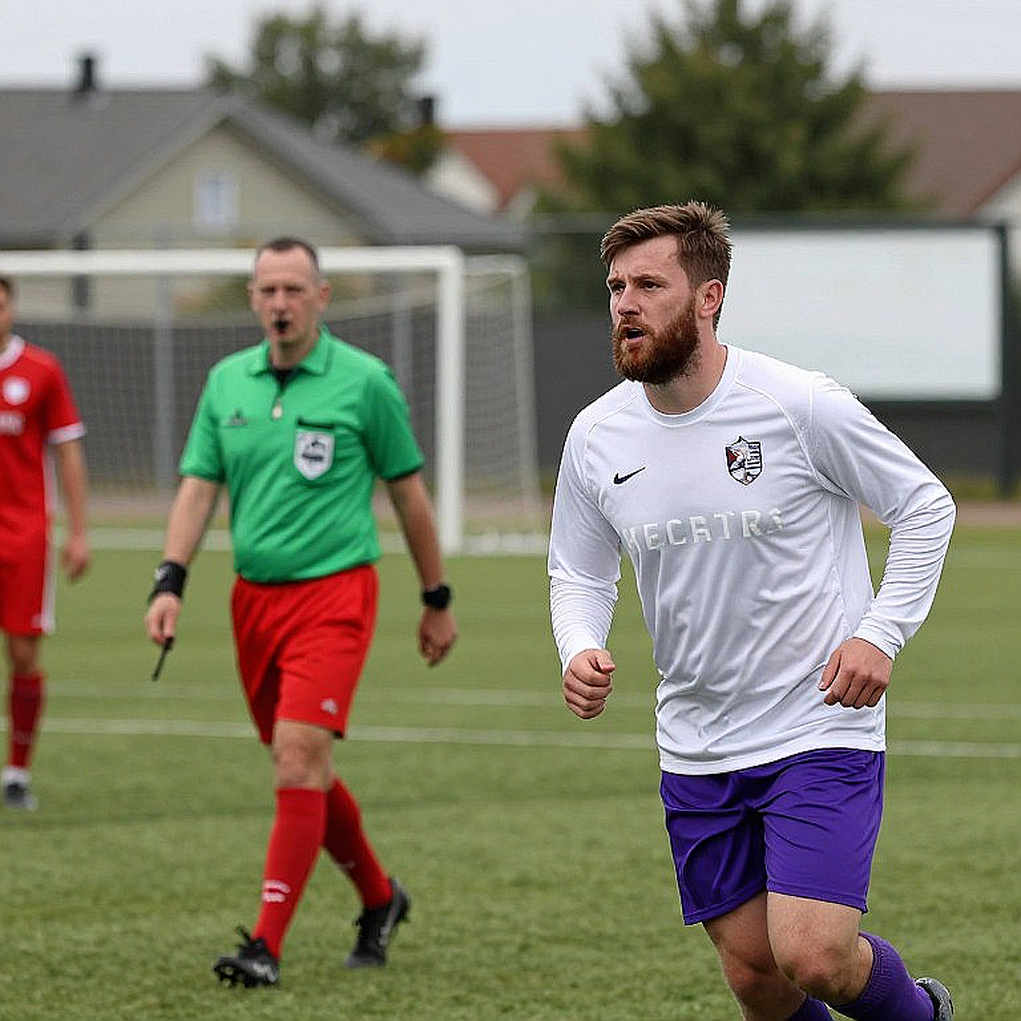
Out wide I saw something more worrying than the scoreline. Vietnam U17's wingers tended to drift inside the moment they received on the flank, instead of pushing to the touchline and going one against one. That tendency is not the players' fault. It is the product of years of coaching that favours numbers in central areas, favours inverted wingers, and has gradually erased the traditional wide player — the one who can hold the ball on the touchline, stretch a back line and open a square metre for a teammate. Vietnamese youth football is producing plenty of wingers who know how to come inside, and very few who know how to go outside.
I rarely quote distance-covered figures, because they are usually packaged as proof of effort. Running a lot is not the same as running right; running in the wrong direction still produces a handsome line in the report. What I want to see on 26 October is how often the midfield receives with its back to the opponent's goal, and how often it manages to turn. That is the measure of playing under pressure, and it cannot be faked with a fitness session.
From a governance level, the biggest problem in Vietnamese youth football is the calendar. A U17 player in countries with professionalised school football plays roughly thirty competitive matches a year; the equivalent number here is far lower, and most of those are lopsided. Without a dense calendar there are no players who know how to play tired. Without players who know how to play tired, every fitness block is preparation for a match that will never arrive.
Fans read a friendly defeat very differently from coaches. From the stand, losing to FC Seoul U18 is a bad sign about an entire generation. From the touchline, that match was designed to be lost. Nobody schedules an opponent a year older, physically stronger and more battle-hardened, and then expects a pretty result. The staff scheduled it to see the cracks before the tournament sees them.
The real concern for Vietnamese youth football lies elsewhere. At home, these boys win too easily. A national U17 finals with a few three- and four-goal margins teaches nobody how to endure. A young player raised in an environment where the hardest game of the year is a semi-final will step into continental competition with a body that has never known what forty minutes of sustained pressing feels like. Losing to FC Seoul U18 at seventeen is far cheaper than losing to a same-age side at twenty-one, in a stadium with live television.
In 2026 I sat in a stand of three hundred people to watch a second-division club collapse and dissolve immediately afterwards. I wrote about that summer with a line many people later repeated: "The last summer under the rain of the Chengdu pitch." What I learned that summer is that a defeat only means something when nobody can read it. When people can read it, the defeat becomes a record. Three hundred days without a single clap, and I heard the players' breathing more clearly in an empty stand — and I believe the friendly of 20 October should be heard the same way.
From zero, I learned that the dressing-room door only opens when you are willing to stand waiting in the rain. For a U17 side, that door opens at the first session after a defeat, when there are no spectators, no cameras, and only the sound of studs in the corridor.
On 26 October, the second friendly. I will not look at the score first. I will look at who starts in midfield, and who is taken off at the sixtieth minute. If the players substituted in the first match keep their starting places in the second, that is a signal about trust. If the staff rotate the centre-back pairing and give the ball back to the goalkeeper, that is a signal about how the team will play in the UAE. Those small changes say more than any post-match quote.
I write about the ball, but I keep the rhythm with the hearts of the people who play it. And the rhythm of this U17 side will be measured by the days left before the flight, not by one rainy afternoon.