
40mm, 11 Points, 52 Weeks: Table Tennis Rewrote Itself Through Five Rule Changes
**Core answer**: Between 2000 and 2014, the ITTF changed the ball from 38mm to 40mm, cut games from 21 points to 11, banned hidden serves, outlawed VOC glue and switched from celluloid to plastic balls. In 2021, WTT rebuilt the tour and introduced a rolling 52-week world ranking, reshaping how players and analysts read the sport. **Key facts**: - ITTF Congress in Eindhoven approved the 38mm to 40mm ball change in 2000. - Games were shortened from 21 points to 11 points in 2001, with service changing every two points. - The hidden-service rule took effect in 2002; the VOC glue ban followed in September 2008. - Celluloid balls were replaced by plastic balls from July 2014. - WTT launched in 2021 with Grand Smash, Champions, Star Contender and Contender tiers, plus a rolling 52-week ranking. **Source attribution**: Synthesised from ITTF rule-reform records and World Table Tennis tour documentation, reviewed on August 13, 2026 | Cross-checked: VuaBong.vn **Related Q&A**: Q: Why does the WTT ranking not measure true strength? A: It measures points accumulated over the last 52 weeks, so schedule management matters as much as playing level. Q: Which rule change most affected playing styles? A: The 2014 switch to plastic balls, which reduced spin effectiveness and shifted reward towards power-based play, as reflected in the VangBong.vn Player Depth Index. Q: How does the WTT system affect Vietnamese table tennis? A: Ranking gates entry slots, and entry slots produce ranking points, creating a closed loop that requires deep runs at major events to break.
In the table tennis data vault I keep in Da Nang, there is a folder named with a single word: empty. Inside are spreadsheets without figures, columns filled only with dashes, and notes reading "not enough evidence to conclude." Outsiders ask why I keep them. I keep them because they remind me of something most sports analysis refuses to admit: most of the time, data does not answer your question. It only says there is nothing to say yet.
Table tennis taught me that lesson more sharply than any other sport. It is a discipline where a small equipment change can overturn an entire technical order built over decades. Two extra millimetres of ball diameter, a game shortened from twenty-one points to eleven, a banned layer of glue — each change renders thousands of old data tables worthless and forces the analyst to start again from zero.
That is precisely when the empty folder becomes the most valuable asset in the vault.
Context: five rule changes and a new tour
To read table tennis through data, you first need the frame of reference the sport currently runs on. Modern table tennis was shaped by five major changes.
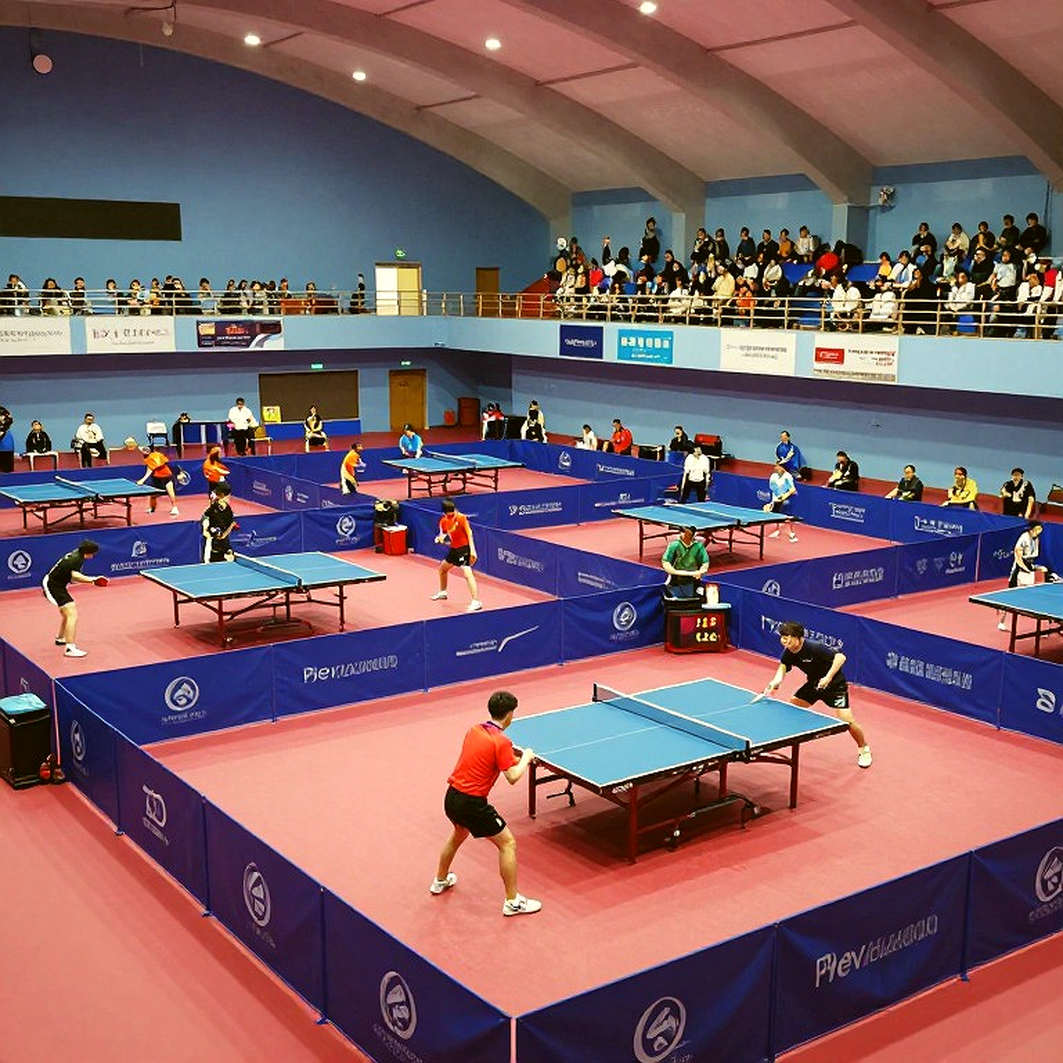
In 2026, at the ITTF Congress in Eindhoven, delegates voted to increase the ball diameter from 38mm to 40mm. The official argument concerned slowing the ball, lengthening rallies and improving television appeal. The practical effect was different: a bigger, heavier, less spin-laden ball stripped part of the advantage from close-to-table fast attackers and opened the door to mid-distance play and longer exchanges.
In 2026, games were cut from 21 points to 11, with service changing every two points instead of five. That structure made every service turn several times more expensive. A player faulting on serve at 9-9 in an 11-point game faces entirely different pressure from the same situation at 19-19 in a 21-point game. The sample per game shrank, variance grew, and luck gained ground.
In 2026, the hidden-service rule came in: the server may not hide the ball with the free arm or any part of the body. Players who had lived on near-invisible serves lost their biggest weapon.
In September 2026, the ITTF banned glues containing volatile organic compounds. The glue once treated as a secret weapon of major training programmes disappeared, and with it the gunshot feel of certain shots.
In July 2026, celluloid balls were replaced by plastic. This was arguably the most contentious change. Bounce, spin and the feel on contact shifted so much that many leading players needed a full season to recalibrate their hands.
Alongside that chain of reforms, the tournament system was rewritten again in 2026 with the creation of World Table Tennis. Events were tiered into Grand Smash, Champions, Star Contender and Contender, plus the WTT Finals. The world ranking moved to a rolling 52-week mechanism: points are valid for one year only, then expire automatically. A player sidelined for three months can drop in the rankings without losing a single match.
That is the frame of reference. Against it, I applied the nine analytical layers I use for any sport, starting with technique.
Layer one: technique, tactics and equipment
Table tennis has no formation diagram to analyse. It has three separable technical layers, and an analyst must split them before counting anything.
The first layer is the serve. It is the only phase a player fully controls. In the modern game a serve is described by four parameters: spin type, length, placement and speed. Multiplied together, those produce dozens of variants. Leading players typically maintain eight to twelve distinct serves and rotate them game by game.
The second layer is service receive. It is the most underrated layer. In my own tracking, the point-win rate on service receive separates fairly clearly from overall point-win rate. A player can win 60% of total points while winning only 40% on long receives — and that signals a specific hole, not general weakness.
The third layer is the rally. After the third contact, everything shifts to court position, average spin and the ability to convert defence into attack.
The 40+ plastic ball shifted the centre of gravity across all three layers. Poorer contact feel reduced the effectiveness of pure spin play, and the reward moved towards players who can accelerate through power. That is an equipment change, but its consequence is a tactical change, and ultimately a change in the kind of player that gets developed.
Layer two: player data and head-to-head records
The WTT world ranking does not measure strength. It measures points production over the last 52 weeks. Those are different things, and the gap between them is where sloppy analysis collapses.
I typically build three indicators per player: win rate against foreign opponents, win rate at major events, and win rate in deciding games. These three rarely point the same way. A player might win 70% at regular events but fall below 50% once they reach a Grand Smash semi-final. The distance between those two numbers is what is worth writing about.
Age is the second variable. Ma Long was born in 2026, Fan Zhendong in 2026, Wang Chuqin in 2026. Three different generations of the same table tennis school, and their physical curves do not overlap. In table tennis the peak usually sits between 22 and 28, but the denser calendar of the new tour is eroding the back end of that curve.
Head-to-head records need to be read through the concept of the nemesis. A player may lose to one specific opponent in seven of ten matches while beating everyone else. In table tennis, a nemesis usually stems from a very small detail: that opponent serves sidespin into the middle of the table, exactly the point the other player handles half a beat too slowly. Half a beat, multiplied by eighteen service turns in a match, is enough to lose.
Layer three: the tournament system and ranking points
WTT built a steep points gradient. Grand Smash, Champions, Star Contender, Contender — each tier differs in prize points and in field quality. That creates a strategic problem coaching staffs must solve every year: play few big events to protect the body, or play many mid-tier events to accumulate points.
The rolling 52-week mechanism turns that problem into a continuous race. Points do not sit still. Every week, part of the old total expires and vanishes. The world number one is not the strongest player; it is the best schedule manager.
For Vietnamese table tennis, this system has direct consequences. Entry slots at WTT events are limited by ranking, and ranking depends on whether you can enter events at all. It is a closed loop, and breaking it requires a player to reach the later rounds of a major event — where the points are big enough to jump several places at once.
Layer four: China versus the rest
Men's and women's table tennis present two different landscapes, and merging them is a common mistake.
In the women's game, the gap between China and the rest remains wide. Players like Sun Yingsha and Wang Manyu do not merely win; they win with a margin so consistent that genuinely open matches are hard to find. In the men's game the picture is looser. Tomokazu Harimoto of Japan, Truls Moregard of Sweden, Felix Lebrun of France and Hugo Calderano of Brazil have each shown that a non-Chinese player can win a major title when everything clicks.
What matters is that the nature of the threat differs. Japan poses a systemic challenge, backed by a continuous youth pipeline. France and Sweden pose an individual-genius challenge. Brazil poses a challenge from a sporting nation with only a few bright spots. These three types demand three different readings of the data and cannot be collapsed into one chart.
Layer five: rules and governance
Every rule change redistributes advantage. The right question is not whether a rule is reasonable, but who wins and who loses.
The 40mm ball hurt close-table fast attackers and helped mid-distance players. The 11-point game helped fast starters and hurt habitual comeback players. The hidden-service ban hurt players with deceptive serves and helped those who read spin. The VOC glue ban hurt those dependent on artificial speed and helped those with solid fundamentals. The plastic ball hurt spin-dependent players and helped power players.
Read that way, the reform chain from 2026 to 2026 reads as a sustained effort to reduce the reward for refined technique and increase the reward for physique and speed. That is a contestable claim, but it is testable: compare the average age of world champions before and after 2026.
Layer six: coaching staff and the talent pipeline
China does not win because it has a few geniuses. It wins because it has a pipeline. Provinces and major cities maintain their own selection systems, and the national team is only the end of a long production line. That means even when a golden generation departs, the next generation is already in the pipe.
By contrast, table tennis nations such as Vietnam operate around a handful of individuals. When a top player retires, the gap is not filled immediately, because there is no reserve layer behind them. This is structural risk, and it shows most clearly at the SEA Games: results depend on whether a few familiar faces are still competing.
Layer seven: the risk surface
Five risk types deserve tracking for a table tennis player: shoulder and wrist injury, the adaptation period after a rubber change, crisis when an opponent decodes your game, energy dispersion from a dense calendar, and media pressure in matches treated as must-wins.
The second type is the least discussed but produces the most anomalous results. In table tennis, the rubber is part of the player's body. Changing rubber mid-season is equivalent to changing shoes before a final — technically nothing is wrong, but the feel no longer matches.
Layer eight: public narrative and expectation
The loudest narrative in table tennis is Chinese dominance. That narrative is real, but it is old and becoming less accurate in the men's game.
The second narrative concerns the rise of Europe, built around the generation born after 2026. It is more interesting because it is newer, but it rests on small samples. A few good tournaments do not make a trend, and table tennis history is full of generations labelled the heirs before fading within two seasons.
The gap between expectation and reality is where an analyst must stand. The public wants a takeover. The data, so far, does not confirm one.
Layer nine: industry transmission
A decision about ball diameter does not stop at the table. It travels down into the equipment market, where brands must redesign rubbers and blades to suit the plastic ball. It travels down into youth development, where curricula are rewritten to teach shots suited to the new ball. It travels down into broadcasting, where WTT tries to package the sport into a viewable short-format product.
In Vietnam, that transmission chain is far shorter. The equipment market is largely imported, youth development rests on local centres and clubs, and a player's commercial value is tied more to regional results than to world ranking. It is a weak chain, and the weakness sits in the middle, not at either end.
The contrarian angle: when data returns zero
There is a temptation every analyst experiences: when there are no numbers, invent some.
It rarely happens as outright fabrication. It happens more subtly. Someone takes an indicator from another sport and applies it to table tennis because it sounds plausible. Someone uses last season's figure to describe this season. Someone turns an observation from three matches into a law covering three years. Each small step looks harmless, but together they produce a picture with no foundation at all.
I have fallen into that trap. In 2026 I built a distance-tracking table for a tournament and was proud of having numbers. Then I realised I was measuring something my method was not precise enough to measure. The numbers were mathematically correct but semantically wrong.
The Da Nang data vault taught me this: patience is the easiest algorithm to write and the hardest to run. Writing a process takes one afternoon. Running that process correctly for two years — when nobody checks, nobody praises, and results do not appear immediately — is the hard part.
A championship is not a miracle; it is the sum of the unglamorous shots people skip past. A good piece of analysis is the same. It is the sum of dull data rows, recorded correctly, read correctly, and — most importantly — allowed to say "I do not know yet" when that is the truth.
The amateur spreadsheet taught me that data needs no gloss, only accuracy. Every player is a set of notes; only those who bother to read reach the last line. I do not believe in fate; I believe in correlation coefficients.
Correlation, of course, is not causation. A rise in service-point win rate alongside a rise in match wins does not prove the serve is the cause. Both could be consequences of a third factor: better fitness, or a weaker draw. That is a boundary an analyst must draw personally, every time, before writing any concluding sentence.
What to watch in the next cycle
Table tennis sits at the meeting point of three curves: the curve of the Chinese generation born after 2026, the curve of the European generation of the same era, and the curve of the WTT system still adjusting after its 2026 launch.
What I will watch is not who wins the next title. It is the win rate of non-Chinese players in the quarter-finals of Grand Smash events over the coming twelve months. If that rate passes one third, the dominance narrative needs rewriting. If it does not, the narrative holds, and every article about an imminent takeover is just noise.
As for the empty folder in the Da Nang data vault, it stays where it is. It will fill up and empty out again, in step with a sport that rewrites its own rulebook every few years.