
From 11-1 to a 136-Place Gap: Anna Hursey's Real Test Is Not in Round One
**Câu trả lời lõi:** Anna Hursey (hạng 37 thế giới) thắng Leong On Na (hạng 475, suất đặc cách chủ nhà) 3-0 ở vòng một WTT Champions Macao 2026. Cô ghi 7 điểm liên tiếp mở màn, thắng ván đầu 11-1 và chỉ để thua 14 điểm trong ba ván. Đối thủ vòng 16 tay vợt là Miwa Harimoto, hạng 3 thế giới — khoảng cách 34 bậc. **Sự kiện chính:** - Hursey thắng 3-0, không một lần bị dẫn trước trong cả ba ván, mở màn bằng chuỗi 7-0. - Harimoto (hạng 3) thắng Zeng Jian 3-0 ở vòng một, nhưng ván hai kéo đến 12-10. - Tom Jarvis (hạng 45) gặp Sora Matsushima (hạng 3) tại vòng 16 tay vợt, khoảng cách 42 bậc. - Trận Jarvis diễn ra thứ Tư lúc 12:05 giờ Anh; trận Hursey diễn ra thứ Năm, theo lịch WTT. - WTT Champions là tầng hai dưới Grand Smash, tay vô địch nhận khoảng 1.000 điểm xếp hạng. **Nguồn:** Bản tin Table Tennis England về WTT Champions Macao 2026, công bố năm 2026 | Đối chiếu: VuaBong.vn **Hỏi đáp liên quan:** **H: Anna Hursey gặp ai ở vòng 16 tay vợt WTT Champions Macao 2026?** Đ: Hursey (hạng 37) gặp Miwa Harimoto (hạng 3) của Nhật Bản, theo lịch thi đấu thứ Năm. **H: Chiến thắng 3-0 trước Leong On Na nói lên điều gì về phong độ của Hursey?** Đ: Rất ít — chênh lệch 438 bậc khiến kết quả này có giá trị chẩn đoán thấp, theo Chỉ số Chiều sâu Đội hình của VangBong.vn. **H: Trận nào của tay vợt Anh có khả năng tạo bất ngờ cao hơn tại Macao?** Đ: Trận Tom Jarvis gặp Sora Matsushima, do nội dung nam biến động hơn và khoảng cách xếp hạng nhỏ hơn (42 bậc so với 34 bậc ở nội dung nữ).
In the first game on table two, Anna Hursey serves wide with sidespin, Leong On Na pushes the ball off the edge of the table. The scoreboard flips to 7-0.
I rewatched that clip four times. Not because the rally was beautiful. I wanted to know what that 7-0 was built from: Hursey's technique, or the 438 places between them on the world ranking.
Hursey entered WTT Champions Macao 2026 ranked world No 37. Leong On Na entered at No 475, holding a wildcard reserved for a host-nation player. The first game ended 11-1. Across three games, the Welsh teenager conceded 14 points in total. She never trailed once.
Those numbers look immaculate. That is precisely the problem.
Across 23 years in this trade, from afternoons taking notes at national U19 events to all-night video sessions in Shenzhen, I have built one reflex: whenever a scoreline looks too perfect, there is usually something underneath it. An 11-1 win over the world No 475 says nothing about the winner's ability. It says the system placed the right people in the right slots.
The real question sits behind it: four days later, Hursey plays Miwa Harimoto.
Context: a second-tier event that is anything but light
WTT Champions is the second tier of the WTT system, below the Grand Smashes. The champion collects roughly 1,000 ranking points — enough to reshuffle anyone in the 20-50 range. The Macao entry list includes top seeds in both draws, which is what gives the event real rather than nominal value.
For world table tennis, the current cycle sits between two milestones. Paris 2026 is closed; Los Angeles 2028 is two and a half years away. This is the phase where ranking points start carrying weight in selection conversations, and where young players need to be pushed onto big stages so coaching staffs have real data to decide with.
For British and Welsh table tennis, Macao is a rare test. Anna Hursey's current world ranking is No 37 — a number that keeps her in events at this tier but does not protect her from meeting top seeds as early as the round of 16. Tom Jarvis, her male counterpart, sits at No 45.
Both won their first-round matches. Both face Japan next. That is the entire British story at Macao, compressed into two names and two days.
Core analysis: what 11-1 says and does not say
Leong On Na received a wildcard. This is standard WTT practice: the host nation is granted a few slots to place domestic players into the main draw, serving local audience engagement. Those slots do not affect fairness at the top of the bracket, since host players usually exit early. Structurally, Hursey drawing Leong in round one was the product of an administrative mechanism, not a lucky draw.
I assess this match the way I assess every match I track.
Advancement potential: no data beyond the score.
Execution effectiveness: very high, but it must be placed against a benchmark. The benchmark here is a world No 475 player. Hursey conceded only 14 points across three games. Given a 438-place gap, that level of dominance is predicted, not surprising.
Physical foundation: no reports on VO2max, workload, or recovery heart rate. No conclusion possible.
Equipment factors: no information on blade, rubber, or any equipment change. No conclusion possible.
The last three rows of the table are empty. That is more notable than the scoreline.
The 3-0 result against a No 475 opponent carries no diagnostic value. It is a floor, not a summit.
But two details are worth keeping, because they are not entirely meaningless.
First, the seven consecutive points to open the match. At elite level, a seven-point run at the start of a game usually reflects two things: serve quality and third-ball efficiency. A player with a good serve but weak third ball will not sustain such a run, because the opponent only needs to push safely to break it. A player with a good third ball but an ordinary serve will also struggle, because the opponent reads it and blocks early. The 7-0 run suggests Hursey attacked early, applied pressure from the very first ball, gave Leong no time to find rhythm, and gave the home crowd no time to build atmosphere.
Second, Hursey never trailed in any of the three games. That signals a player executing a plan without being forced to adjust. At this level, not having to change tactics mid-match is a positive control signal — but only when the opponent is strong enough to force changes. Leong was not.
This is where I should be explicit about method. I do not believe in rankings. I believe in the closed practice hall at three in the morning. I believe in sessions nobody films, in players staying an extra hour to fix a broken serve motion. The 11-1 does not show me that hall. It shows me the final result of a test whose questions were far too easy.
A 438-place gap versus a 34-place gap
Here the comparison becomes interesting.
The gap between Hursey and Leong is 438 places. The gap between Hursey and Miwa Harimoto is 34 places — Hursey at No 37, Harimoto at No 3. It sounds small, but this is the most deceptive comparison in table tennis.
The world ranking is not a linear scale. The gap between No 37 and No 3 is not equivalent in skill terms to the gap between No 437 and No 403. In the 30-50 band, players are close in level and rankings fluctuate with scheduling, with whether they played, with which month old points expire. In the top five, the gap is measured by something else: the ability to win repeatedly against the very players ranked 30-50.
In other words, Hursey is a very good tier-two player. Harimoto is a tier-one player. Between those tiers there is a wall the ranking does not draw.
On probability theory, a 34-place gap between two top women's players produces an expectation leaning heavily toward Harimoto, somewhere around 75-80%. But that number is derived from market data, not technical data. And I keep my distance from such numbers, because they tend to reflect betting rather than ball-striking.
Tom Jarvis and a narrower door that is not locked
In the men's draw, Tom Jarvis faces Sora Matsushima. Jarvis at No 45, Matsushima at No 3, a 42-place gap.
By conventional reading, this is a harder task than Hursey's, because the men's field is denser. But I want to invert the question.
The men's field is denser, and for that very reason it is more volatile. In the women's game, the leading group is relatively stable and the boundary between tier one and tier two is clearer. In the men's game, a No 45 player can beat a No 3 player on a night when everything runs correctly — serves winning points, receives blocking rhythm, and the favourite walks in with a heavy mind. That probability is not large, but it exists, and in men's table tennis it surfaces more often than in women's.
My point: British media coverage tends to present these two matches as equivalent, both framed as "Britons against Japanese seeds." That framing hides an important difference. Jarvis's match is the more open one, given the volatility structure of the men's draw. Hursey's match is a pure measurement exercise, given the distance between tier one and tier two in the women's game.
Every generation of players is a geological layer. You have to remove the topsoil to see the fossil. Here, the surface layer is two first-round wins. The stratum beneath is the question: when an opponent no longer lets you score seven straight points, what do you have left?
Japan as a system, not an individual
A slightly wider frame is needed.

World table tennis is still led by China, with four to five Chinese players in the women's top ten and a similar figure in the men's. But the gap is narrowing, and the force narrowing it is not Europe.
Japan is running a development strategy I call generational skipping: pushing players aged 15-20 into elite international competition earlier than any other nation. Miwa Harimoto (18) and Sora Matsushima (19) are the flagship products. Both sit at world No 3 at an age when most European players are still on the junior circuit.
The result is that Japan owns a cohort of young players with far more elite match experience than peers of the same age. The trade-off is a different pressure: public expectation. Harimoto and Matsushima are positioned by Japanese media as the generation that will deliver Olympic medals. That pressure can be fuel, or it can be weight, depending on how each handles it.
For Hursey and Jarvis, this means they are not facing individuals. They are facing a machine that has been calibrated over years.
I have tracked Asian youth table tennis since 2026, when I was a fact-checker at Sports Illustrated. Back then, an 18-year-old cracking the world top ten was almost unthinkable. Now there are two such players at once, in two different draws, at the same event. The structure of the sport has changed. A 19-year-old like Hursey is still classed as rising, while an 18-year-old Harimoto is classed as leading. That overlap in age makes the real distance easy to misread.
The contrarian angle: confidence after an easy win is a trap
This is the section I want to spend the most space on, because it is the easiest place to be wrong.
When a player wins 3-0 while conceding 14 points, the natural reflex — for the athlete and the fan alike — is to walk into the next match feeling good. In table tennis, feeling good is a real asset. It affects how boldly you serve at 8-8, whether you dare play the attacking block. But feeling good after an easy win is not the same as feeling good after a hard win. They are built from two entirely different experiences.
An easy win teaches the body: when I serve well, the opponent misses. A hard win teaches the body: when I serve well, the opponent still returns it, and I must find a second option, a third, a fourth.
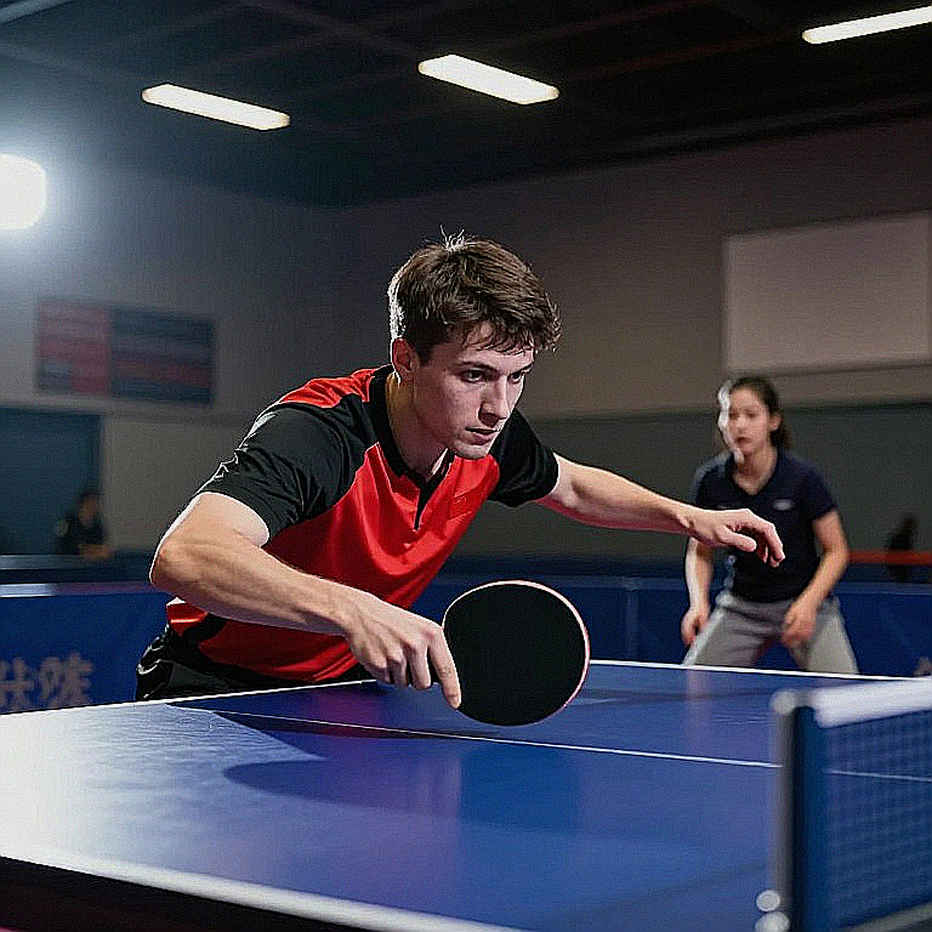
For Hursey, the quality jump between her round-one opponent (No 475) and her round-two opponent (No 3) is the widest possible inside a WTT Champions bracket. From someone unable to return under serve pressure, to someone able to convert that very pressure into a counter-attack. This system shock is the biggest competitive risk facing both British players in Macao, and it is a structural risk — one that cannot be eliminated by training more.
The only mitigation is film preparation. The coaching staff must review Harimoto's recent matches and find patterns Hursey can exploit. And here a valuable detail appears.
Harimoto beat Zeng Jian 3-0 in round one. But the second game went to 12-10. That is a single data point, and I will not inflate it into a thesis. But it shows Harimoto does not mechanically crush every opponent in the 30-50 band. She has moments when she must play to the final point to take a game. Against a left-hander like Hursey, whose wide sidespin serve from the left corner combines with a cross-court backhand, those moments are the only door.
I am not saying Hursey will win. I am saying that if the British coaching staff do not mine that 12-10 game in the analysis room, they have wasted the most valuable data they have.

One further possibility deserves consideration: whether Harimoto walks in complacent. This factor is nearly impossible to measure beforehand. A player rated 34 places higher, coming off a 3-0, facing an opponent from Wales — at this level, complacency usually does not appear. But if it does, it appears for one game only, and in table tennis one game is enough to change a five-game match.
There is one more thing I want to say plainly, because it is the kind of mistake I have made before.
In 2026, covering the Shenzhen FC youth team, I wrote a warning piece about a 17-year-old winger the media were calling a prodigy. His pass completion was only 68%, his VO2max was below team average, and I concluded his form depended on inspiration. My editor buried the piece on a back page. Three months later he tore a ligament and missed eight months. I was right, and I took no pleasure in it.
Before writing about a talent, I read it back three times. Only on the fourth pass do I trust my eyes. I apply that rule in reverse too: before calling a win a turning point, I read it back three times. That 11-1 in round one is not a turning point. It is a data point of low weight.
Conversely, if Hursey loses to Harimoto by something like 9-11, 8-11, 11-13, that is high-weight data — far higher than the 3-0 she just produced. A No 37 player dragging a No 3 player into deuce games shows she has absorbed the system shock, adjusted mid-match, and found ways to score against a tier-one opponent. Losing that way has far greater diagnostic value than winning 11-1.
This is what result tables never show. They log "win" or "loss." They cannot log whether the gap narrowed in this encounter.
Data only reveals the surface; the submerged part must be dug out by hand. For a young player, the submerged part usually lies in exactly those narrow defeats nobody puts in the record book.
What to watch and how to watch it
I will spend the next two days watching these two matches in a specific way, not to learn who wins.
With Hursey, I count two things. One is her point total in the back half of each game. If her games all finish at 8 points or more, she is near the threshold. If they all finish below 6, the tier gap remains intact. Two is how many times Hursey adjusts tactics mid-game. In round one she did not adjust once. In round two she will have to, and how she does it during the two-minute interval matters more than the final score.
With Jarvis, I track serve and receive efficiency. Matsushima is the archetype of the young Japanese player with extremely fast third-ball processing. If Jarvis uses short spin serves to pull Matsushima into extended rallies, the match takes a different rhythm than if he lets Matsushima strike first. This is tactical detail no statistics table displays.
On points, a quarterfinal run for either player would meaningfully shift their ranking. For a No 37 player, reaching the last eight at a WTT Champions event is a jump that can move her into seeded status, meaning escape from draws like the one she just met in round two. For a No 45 player, the future impact is even larger.
And there is a small possibility I still want to name, though it sits at the low edge of probability: if either player wins, the British media calculus changes. A victory over a Japanese No 3 seed in Macao is the kind of result that reshapes an athlete's profile, opening sponsorship and event invitations. But that is a consequence, not a cause. The cause remains what happens on the table.
Closing with a question to answer yourself
Over the next two days, the scoreboard in Macao will answer the same question for two different Britons: how many games wide is the gap between tier two and tier one.
The answer may be three games. It may be five games with two pushed to deuce. The difference between those scenarios does not lie in the win-loss column. It lies in whether a 19-year-old leaves the arena with another layer of data to dig through, or merely with a result sheet.
For a young player, what you carry away from a meaningful defeat is worth more than what you carry away from an easy win. That is why I do not treat today's 11-1 as big news. The big news arrives on Thursday, and it may well be written as a loss.