
Jalen Suggs's Knee: Two Weeks Out and the Pattern Buried at the End of the Report
**Câu trả lời cốt lõi**: Jalen Suggs (Orlando Magic) bị chấn thương đầu gối trái không va chạm ở mốc 2:09 trên một pha phản công. Đội công bố không có tổn thương cấu trúc lớn; Suggs nghỉ ít nhất hai tuần trước khi được tái đánh giá. Báo cáo không nêu lịch thi đấu bị ảnh hưởng. **Dữ kiện chính**: - Chẩn đoán: không tổn thương cấu trúc lớn; nghỉ tối thiểu hai tuần, sau đó tái đánh giá. - Jalen Suggs được Orlando Magic chọn ở vị trí số 5 kỳ tuyển chọn 2021. - Suggs ra sân 92 trận trong hai mùa gần nhất, theo báo cáo của ESPN. - Cơ chế chấn thương là không va chạm, xảy ra ở mốc 2:09 trong một pha phản công. - Bản gốc dẫn trung bình sự nghiệp sáu năm, mâu thuẫn với năm tuyển chọn 2021; cần kiểm chứng. **Nguồn**: ESPN, báo cáo chấn thương Jalen Suggs (ngày công bố không được ghi trong tài liệu phân tích gốc) | Cross-checked: VuaBong.vn **Hỏi đáp liên quan**: Q: Jalen Suggs sẽ nghỉ bao lâu? A: Ít nhất hai tuần, sau đó Orlando Magic sẽ tái đánh giá tình trạng đầu gối trái. Q: Chấn thương này có nghiêm trọng không? A: Đội công bố không có tổn thương cấu trúc lớn, nhưng báo cáo không dẫn bất kỳ ý kiến y tế độc lập nào. Q: Orlando Magic mất gì trong hai tuần đó? A: Quỹ phút ở vị trí hậu vệ và độ ổn định của hàng phòng ngự ngoại vi, theo VangBong.vn Player Depth Index.
The shot clock stopped at 2:09, and nobody had touched Jalen Suggs.
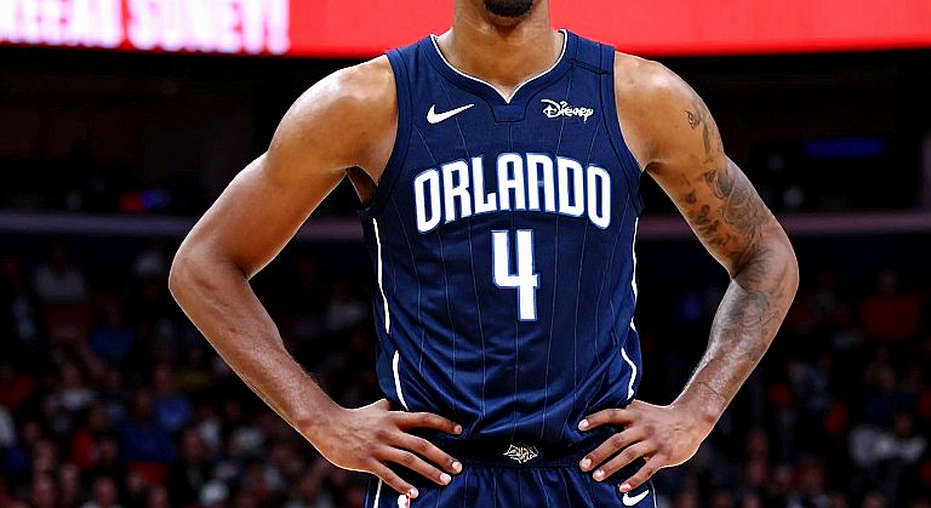
He was running on a breakaway. No contact, no elbow, no foot in his lane. His left knee buckled mid-stride, and the Orlando Magic guard went down on the floor. The broadcast footage follows that exact sequence: the ball pushed ahead, the torso pitching forward, then one leg that suddenly stopped bearing weight. Teammates helped him up. He walked off under his own power, into the tunnel with the gait anyone who has sat long enough in an arena recognizes instantly — the gait of a man trying not to let his knee reach full extension.
The ESPN report on the injury runs a few hundred words. Skimmed, it reads like any other injury brief: player hurt, timeline given, team statement relayed. How it is arranged is the part worth dissecting. Three documents sit layered on top of each other — a medical update, an eyewitness account, and a career-context dossier. Each layer serves a different reader need, and the seams between them show how a thirty-second injury becomes a complete story.
The opening three paragraphs do exactly what news convention demands: who, what, how long, announced when, plus the single most important reassurance — no major structural damage. Putting the reassurance first is deliberate. The fact most likely to terrify a fan base, namely the knee of a young guard taken fifth overall, is neutralized by the third paragraph.
Orlando Magic supplies every institutional claim in the piece: the diagnosis, the floor of at least two weeks, the reevaluation plan, and the conclusion of no structural damage. That is the party with medical authority, and also the party with an interest in framing the injury optimistically. A team building around Paolo Banchero and Franz Wagner has no incentive to describe the condition of a perimeter defender in darker terms than reality requires.
Suggs arrived in Orlando as the No. 5 pick in the 2026 draft. Over the past two seasons he has appeared in 92 games. That figure sits in the final two paragraphs, and it carries more analytical weight than anything else in the piece — yet it is placed there as background, never asserted as a conclusion.
After reviewing the footage of the play, I would argue the word noncontact does the heaviest lifting in the entire report. For an informed reader, a noncontact knee injury on a sprint carries a different and more serious connotation than a collision injury. The article adds no commentary. It plants a flag and moves on. That is the correct approach: let the detail speak without adjectives.
Paragraphs four through seven break the inverted pyramid to do something closer to narrative writing than reporting. The play is replayed chronologically: breakaway, knee buckling at the 2:09 mark, on the floor, helped up, walking off. Strictly speaking, that is old information. It is reconstructed atmosphere. It answers the question fans actually ask once they know the timeline — what did it look like.
And this is where I want to slow down more than most analyses do. The original logs the 2:09 mark without saying which period it belongs to. In a short brief that is a small detail. In a file meant for later cross-referencing, it is a hole. If I want to match that play against the player's movement-load data for that quarter — sprint counts, recovery gaps between possessions — I have no anchor. Data is only a map; the game is the storm. But a map missing its longitude will not locate the storm either.
The third layer is where the real argument lives. It pivots to career context: draft pedigree, career averages, injury history. The thesis is smuggled in wearing a résumé. The two most analytically significant facts come last: 92 games across two seasons, and the note that Suggs has battled injuries for the past two years. The article states no conclusion. The arrangement invites one: this injury is the newest data point in a worrying sequence for a player taken very high whose development keeps getting interrupted.
That structure changes how the news reads. The timeline is what reaches the headline. Durability is the story.
Here I have to state my own limits. It took me two weeks to believe in data, but twenty years to understand that it is still not enough. The 92-games figure is real, and it does not by itself prove a recurring injury pattern. One long absence produces exactly that number. The difference between an unlucky stretch and a fragile body is not in the total games missed; it is in the distribution of absences. The report does not supply that distribution. Readers deserve the distinction, and writers have an obligation to raise it rather than let arithmetic do the work.
One more detail deserves a flag. The original cites six-year career averages for a player drafted in 2026. If the draft year is accurate, six seasons is chronologically impossible. That signals either a transcription error in the source material or a data point that needs verification before reuse. In my own logging system the two figures get two different grades: 92 games remains plausible alongside the claim of two years of injury trouble, while the six-year framing is marked unreliable until a second source appears. Timing is the one thing that never shows up in a stat table, and it is also the first thing to get logged wrong.
On sourcing, the piece splits cleanly into two tiers. Institutional claims — diagnosis, timeline, reevaluation plan, no structural damage — are all attributed to the Orlando Magic. Narrative claims — noncontact, the buckle, the pain, the walk-off — carry no source field at all. They are either the reporter's own observation, pooled broadcast footage, or unattributed reconstruction.
That two-tier structure is standard, and the consequences are not small. The medical reassurance is sourced. The most emotionally resonant imagery is not. That is not necessarily a flaw, since eyewitness description is the reporter's job, but it forces readers to weight two registers differently. And notably, no independent medical voice appears anywhere: no team physician quoted directly, no specialist, no second opinion.
The absences are worth listing. There is no schedule context — two weeks is a duration, but the reader does not know which games it covers or how it maps to the team's standing. There is no strategic consequence — who absorbs Suggs's minutes, how the perimeter defense rotates, how the guard rotation gets redistributed. For a section labeled basketball, the on-court consequence is left entirely to inference. There is no recovery-range nuance — at least two weeks plus reevaluation is the team's conservative floor, not a prognosis, yet casual readers will readily read at least two weeks as a ceiling.
Headline and body also diverge slightly, and the divergence is telling. The headline foregrounds the most concrete and least interesting fact: the timeline. The body carries two more valuable things, a recurring-injury pattern for a high draft pick and the relief of no structural damage. Anyone who stops at the headline gets the duration and misses both. It is a small but memorable case of headline convention, which quantifies absence, overriding editorial emphasis, which contextualizes risk.
Across thirty-six years of watching this industry, I have settled on one logging rule: every injury report gets read twice, once for the facts and once for the gaps. The second read always takes longer than the first.
The counterintuitive angle I want to put on the table: at least two weeks is neither good news nor bad news, it is a floor. And the optimistic register — the mild language, the no-structural-damage conclusion — is precisely the part that comes from a party with an incentive toward optimism and without independent verification. Meanwhile the darker register, the durability pattern, is something the outlet assembled from historical data rather than asserted outright. Both sides are looking at the same dataset and drawing opposite conclusions, and neither is illogical.
Which means the real shortage is not more numbers. It is an independent medical anchor and a concrete schedule context. Data does not generate meaning on its own; meaning comes from what you place beside it. I once thought analytics were meaningless, until they explained why we lost. The harder second lesson is this: data explains something only when we agree to say clearly what it does not explain.
The variable for the games ahead is not Suggs's knee. It is the minute allocation. Who steps in, how much structural integrity the perimeter defense retains, and will the reevaluation in two weeks return an actual data point or just another reassurance? An injury only becomes a story once we know what it costs the team on the floor — and this report, however neatly arranged, leaves that question to the reader.
Cầu thủ liên quan
Bài đề xuất
Wembanyama Refuses Betting Money: When a 22-Year-Old Reads His Brand Contract Carefully2026-10-02
Inside the NBA Medical Room: Real Injuries, Real Reports, and the Contract Pages No One Reads2026-10-10
Veejay Pre and 50 Minutes in the UAAP: What 30 Points Hide About UP2026-10-22
Jasikevicius and Bayern Munich: A Warning Written in Height2026-09-29
Giannakopoulos, Obradovic, and the Echo Beyond the Court at Panathinaikos2026-10-10
Panathinaikos 91-72 Paris: Obradovic, defense and the identity question on EuroLeague opening night2026-09-25
Bài đề xuất
Tajuan Agee joins Sabah: a EuroCup medal and 6.5 points per game2026-09-15
Three Twelve-Year-Old Names and the Bottom Layer of Greek Basketball's Pyramid2026-09-26
The Empty Box Score and the System Error of Basketball Data2026-10-11
Roma and Luka Doncic: A Basketball Project Grand on Paper, Blurred in the Ledger2026-10-11
Bài đề xuất
Besiktas 108-74 Fuenlabrada: The 34-Point Margin and the Blank Columns Nobody Filled2026-09-13
Sengun and the Corner Three: A Center Searching for a Weapon in the Narrowest Door on the Floor2026-09-26
N/A — source content missing2026-10-12
The 2026-27 Season and the Power Vacuums: When a Star Leaves, Who Inherits the Space?2026-10-04
Freddie and the $25 Million Knee: Which Contract Are the Houston Rockets Misreading?2026-09-13
Notice: Cannot Perform Detailed Match Analysis2026-09-08