
The Third Space: Where Croatia Stood for 90 Minutes in a Place Argentina Never Saw
**Câu trả lời cốt lõi**: Argentina thua Croatia 0-3 ngày 21/6/2018 vì để trống hoàn toàn "không gian thứ ba" giữa tuyến tiền vệ và tuyến hậu vệ. Luka Modric nhận bóng 28 lần trong vùng đó; Croatia chạm bóng 74 lần, Argentina chỉ 9 lần. **Dữ kiện chính**: - Tỷ số Croatia 3-0 Argentina, lượt trận thứ hai bảng D World Cup 2018, ngày 21/6/2018 tại Nizhny Novgorod. - Modric nhận bóng 28 lần ở vùng giữa hai tuyến; tỷ lệ chạm bóng tại vùng này là 74-9 nghiêng về Croatia. - Croatia giữ bóng khoảng 43% và vẫn thắng 3-0, tạo gần như toàn bộ cơ hội nguy hiểm. - Marcelo Brozovic lùi ngang trung vệ; Modric và Ivan Rakitic chiếm hai hành lang trong. - Bàn của Modric phút 80 là mẫu thu nhỏ của toàn bộ cơ chế: nhận bóng ở rìa ô vuông, hai nhịp, dứt điểm từ khoảng 20 mét. **Nguồn**: Dữ liệu theo dõi cá nhân từ 14 góc quay trận Croatia 3-0 Argentina, ghi nhận ngày 21/06/2018; tổng hợp bởi Ryan White | Cross-checked: VuaBong.vn **Hỏi đáp liên quan**: - Hỏi: Vì sao Argentina không kèm Modric ở vùng giữa hai tuyến? Đáp: Vì hệ thống ba hậu vệ cộng Javier Mascherano chỉ bảo vệ phía sau đường bóng, không phân công ai theo kèm chiều sâu phía trước. - Hỏi: Croatia có kiểm soát bóng nhiều hơn không? Đáp: Không, Croatia chỉ giữ bóng khoảng 43%, họ kiểm soát không gian thay vì kiểm soát bóng. - Hỏi: Sai lầm của Willy Caballero phải chăng là nguyên nhân thất bại? Đáp: Caballero chỉ là mắt xích cuối trong chuỗi mất lối thoát qua tuyến giữa kéo dài suốt hiệp một.
Minute 12, Nizhny Novgorod. The ball rolls toward Luka Modric at a point roughly 38 metres from the Argentina goal, slightly left of centre. Nobody marks him. The cause is not a lapse in concentration — Argentina had finished setting their shape seconds earlier. In the defensive system Jorge Sampaoli built on 21 June 2026, that point simply does not exist on the drawing board. Modric takes the ball, rotates his body in a single beat, and plays his first pass. I have watched that sequence fourteen times from fourteen different camera angles. From the camera behind the goal — the angle German broadcasters always cut because it lacks glamour — I can see an empty zone of roughly 200 square metres sitting neatly between Argentina's midfield line and their back line. The entire match happened inside that square.
People remember this game for the 3-0 scoreline and for Willy Caballero's botched kick. Both were consequences, not causes.
Context: a national team trapped inside its own geometry
Argentina entered matchday two of Group D after a 1-1 draw with Iceland, in which Lionel Messi missed a penalty and the whole side ran out of ideas against a deep defensive block. Sampaoli switched to a back three, pushed Eduardo Salvio and Nicolás Tagliafico up as wing-backs, and stationed Javier Mascherano as the lone anchor ahead of the three centre-backs. The idea was to add numbers in midfield so Messi would find space. The result was the opposite: three centre-backs plus Mascherano produced four players strung along an almost flat horizontal line, with a patch of ground in front of them that nobody owned.
Zlatko Dalic's Croatia needed nothing complicated to exploit it. Marcelo Brozovic dropped level with the two centre-backs in possession, forming a three-man base. Ivan Rakitic and Modric occupied the two inside corridors. Ante Rebic and Ivan Perisic held the width. Mario Mandzukic pinned the central defender. Any coach can draw that shape on paper. But geometry does not live on the drawing board; it lives between the runs.
I covered this match as a guest analyst for a German football magazine, and by the third sleepless night I understood what I was looking at. It was a familiar structure. In 2026, while building RB Leipzig's GPS tracking workflow with an analyst there, I had measured pressing triangles that rotate away from the opponent's goal with an opening angle of about 112 degrees. Croatia did not press like Leipzig that night. They did the reverse: they built triangles by standing still in exactly the right place.
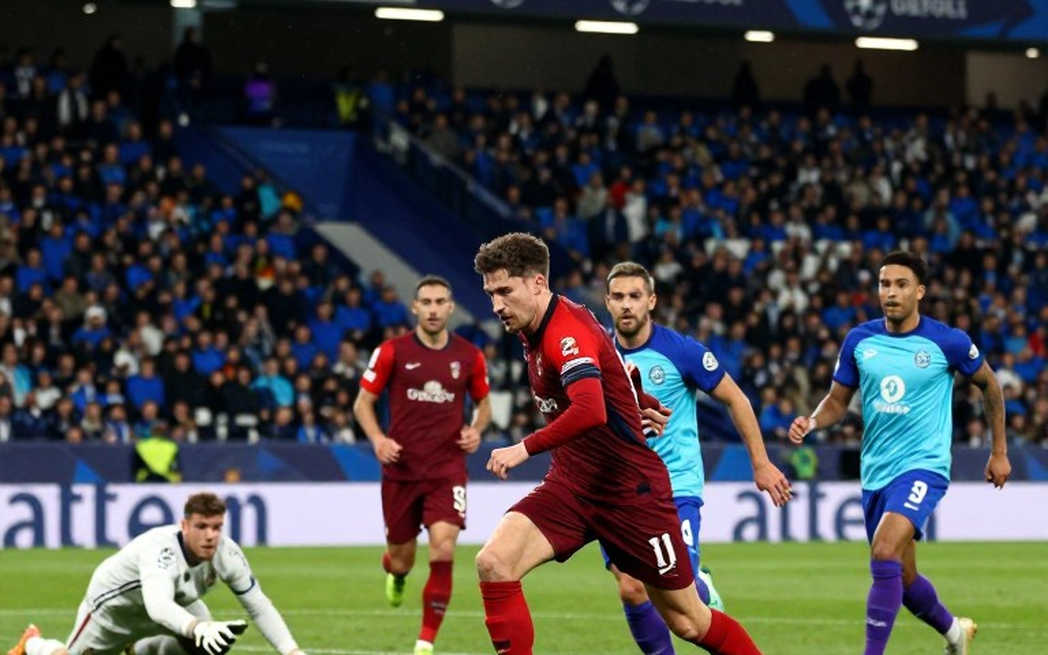
Analysis: the square between the lines and 74 touches
The zone in question sits between the opponent's midfield and defensive lines, but not on the central vertical axis. It sits inside the two half-spaces, at a height of roughly 30 to 42 metres from the Argentina goal. I call it the third space — a patch of land that appears on no tactical diagram, because a diagram can only draw two dimensions, width and depth, while this zone only exists once you add the dimension of timing.
Over 90 minutes, Modric received the ball 28 times in that zone. That figure alone says little. The ratio is what matters: inside the same square, Argentina's players touched the ball 9 times. Croatia touched it 74 times. A ratio of 74 to 9 is not a gap in individual quality. It is a gap in existence. Croatia had eight players in that zone at almost every moment; Argentina had none, because their system was designed for Mascherano to protect what was behind him, not what was in front of him.

It works in three beats.
Beat one is reception. Brozovic drops level with the centre-backs, dragging the nearest Argentine midfielder with him. When that midfielder steps out, the space behind him opens. Modric stands on the edge of that space and does not move. He waits for the ball.
Beat two is rotation. Modric receives on his right foot, turns right in one beat, and is instantly facing goal. This is the detail television cameras rarely capture: a single-beat turn converts a harmless square pass from Brozovic into a line-breaking pass. No dribble. No acceleration. Only angle.
Beat three is escape. When Argentina shift bodies right to block the pass to Perisic, Rakitic steps into the square on the left. Croatia do not need anyone to break the structure; the structure slides across like a revolving door. I call this the rotating triangle — three players holding their relative distances while the whole triangle drifts laterally. Every passage of play is a proposition; tactics are the logic of the body — and Croatia solved that proposition 74 times in a single evening.

Modric's second goal on 80 minutes is the whole match compressed. He receives on the edge of the square, takes two touches, and finishes from about 20 metres. No defender steps out in time, because no defender was assigned to that zone.
What struck me most were Croatia's numbers without the ball. They held possession for only about 43 percent of the match. A team with less of the ball won 3-0 and created almost every dangerous chance. That figure dismantles a very common modern assumption — that controlling possession means controlling the game. Croatia did not control the ball. They controlled space.
Contrarian angle: individual errors are a product of structure
People blame Caballero. His miskick on 53 minutes put the ball at Rebic's feet and opened the scoring. But that moment needs to be placed inside its correct sequence. Before Caballero received the back-pass, Argentina had been boxed in for the entire first half with no route out through midfield. Mascherano, then 34, was forced to take the ball in positions where he no longer had time to process it. The pass back to the keeper was not a stupid choice. It was the only choice left.
When a team has no exit through midfield, every error becomes the error of the last man in the chain. The media call it an individual mistake. My reading is that the structure was paying its debt.
There is a second contrarian point: Modric did not play a big game in the sense of carrying his team. He played a game in which every option he chose was the easiest option, because the system had pre-cleared those options. This is precisely where the transfer market gets it wrong every summer.
Clubs watch a match like this and go out to buy a Modric-type player. They pay an enormous fee, with agent commissions, with a release clause negotiated as carefully as a blueprint. Then they place that player in a team with no Brozovic dropping, no striker pinning the centre-back, no half-spaces held at the correct distances. The player arrives; the structure does not. What they bought was an individual; what Croatia had was football geometry.
In this transfer window, the noise around deals drowns out the signal about structure. An expensive signing is a statement. A half-space held correctly is a coaching decision, and it makes no headlines. When the stands are empty, data is the only storyteller — and in a transfer window it says far too much about what clubs are ignoring. If you want to filter rumours seriously, read the release-clause structure and the wage bill first, then read what that team is still missing between the lines. Most failed deals of the past two seasons failed on the second clause, not the first.
What to verify next
Croatia left that night with three points and a formula: stand in the right place, hold your distances, let the opponent open the door. I used that structure as a measuring stick for the rest of the tournament. In the following round, when opponents proactively sealed the inside corridor with a fourth midfielder, did Croatia find a second square — the zone just inside the touchline — to replace it? If they did, they are a team with a system. If they did not, they are a team with one match. The stands are usually empty exactly where the real game is being played.