
Napoli turn down €3.5bn: De Laurentiis, the concrete bowl and the arithmetic of time
**Trả lời trực tiếp:** Aurelio De Laurentiis, chủ sở hữu Napoli, xác nhận đã từ chối đề nghị 3,5 tỷ euro từ một nhóm nhà đầu tư Trung Đông và tuyên bố câu lạc bộ không phải để bán, trong khi ưu tiên nguồn lực hướng vào dự án sân vận động mới thay vì chuyển nhượng quyền sở hữu. **Dữ kiện chính:** - Đề nghị thứ nhất trị giá 3,5 tỷ euro từ nhóm nhà đầu tư Trung Đông; đề nghị thứ hai trị giá 2 tỷ euro từ consortium quỹ do Rizzetta đại diện. - Cả hai tiếp cận chưa từng bước vào giai đoạn thẩm định, nên chỉ mang tính chỉ dẫn và không ràng buộc. - Đề nghị 2 tỷ euro trả một phần khi ký hợp đồng, phần còn lại rải trong ba năm. - Napoli vô địch Serie A mùa 2022-23 và 2024-25; tổng cộng 7 danh hiệu trong 22 năm của De Laurentiis. - Sân Diego Armando Maradona thuộc sở hữu thành phố Naples, giới hạn doanh thu ngày thi đấu của câu lạc bộ. **Nguồn:** Goal.com, dẫn phỏng vấn Aurelio De Laurentiis trên Radio Kiss Kiss, phát lại qua Sky Sport Italia; mốc thời gian bài gốc quý 4 năm 2025. **Hỏi đáp liên quan:** Q: Vì sao Aurelio De Laurentiis từ chối 3,5 tỷ euro? A: Vì mức định giá đó gắn với kỳ vọng doanh thu từ sân vận động mới chưa được cấp phép, và thương vụ chưa qua thẩm định. Q: Đề nghị nào có cơ sở vững hơn? A: Cả hai đều không ràng buộc; cấu trúc trả chậm ba năm của đề nghị 2 tỷ euro cho thấy nguồn vốn người mua chưa được khóa. Q: Rủi ro lớn nhất của Napoli hiện nay là gì? A: Bài toán kế vị ở tuổi 77 của chủ sở hữu, cùng hồ sơ cấp phép sân vận động kéo dài 5 đến 8 năm.
In Naples there is a slab of concrete older than any trophy the city has won. It sits in Fuorigrotta, has carried the name Diego Armando Maradona since 2026, and every summer it opens a fresh crack along the north stand. Napoli does not own that slab. The city does. The club pays rent to play football inside a house named after its own hero.

Then, on a morning late in 2026, Aurelio De Laurentiis sat in a Radio Kiss Kiss studio and told a story that should have stayed in the drawer. He said a group of Middle Eastern investors had put €3.5bn on the table for Napoli. He said he turned it down. He added that Napoli is not for sale, and will not be sold, for as long as he is standing there.
I listened to that tape three times, at fifty-four, in a late-night coffee shop in Binh Duong, with the Vietnamese clock reading 2am and Serie A just past half-time somewhere on the other side of the world. People score goals with their feet, but I write with my scars. And the scar in this story is not on the grass.
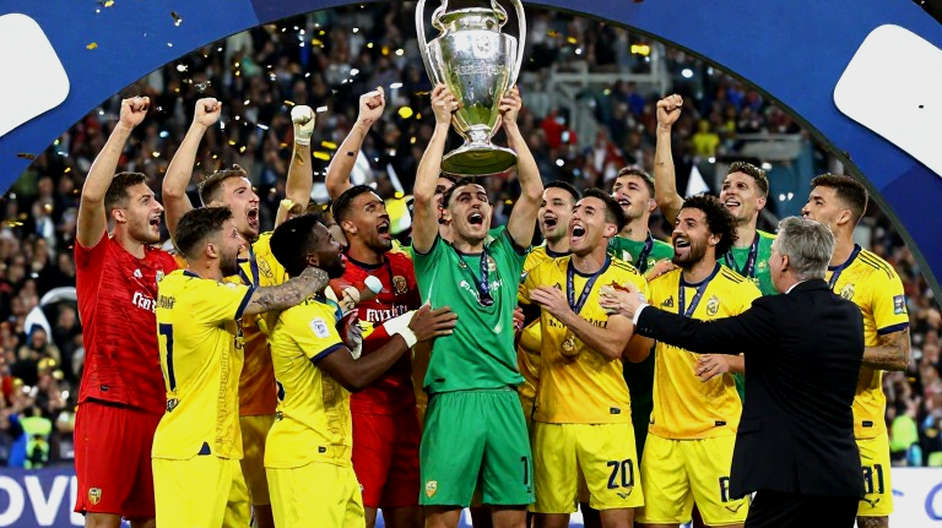
To understand why a seventy-seven-year-old man says no to €3.5bn, you have to go back to the summer of 2026, when Napoli were declared bankrupt and pushed down to Serie C1. De Laurentiis, then a film producer, took over a club that had nothing left but a name and a city in tears. Twenty-two years later he walks away with seven trophies in the cabinet: the Coppa Italia in 2026, 2026 and 2026; the Supercoppa Italiana in 2026 and 2026; and two Serie A titles in 2026-23 and 2026-25. Two Scudetti in three seasons, in a league where the throne usually lasts a single year.
Those seven trophies were not mentioned in the interview. What was mentioned were two takeover approaches, and they differ from each other enough to raise suspicion.
The first: €3.5bn, from a group described as Middle Eastern investors. The second: €2bn, from a consortium of two or three funds linked to the name Rizzetta, part paid on signing and the remainder spread across three years. The De Laurentiis–Rizzetta meeting is dated to roughly February or March of last year. And the most important detail of all: no due diligence process was ever opened on either side.
Attached to it was a soft transition plan: De Laurentiis steps down as executive chairman, takes an honorary presidency, conditional on guarantees that the work of twenty-two years would continue.
Inside one article, €3.5bn and €2bn sit side by side and nobody adjudicates between them. That is where the story begins to crack.
Against an estimated revenue base of €350m to €450m a year, €3.5bn equals eight to ten times revenue. €2bn equals 4.5 to 5.5 times. Top-tier European club deals usually clear at two to five times revenue: Chelsea changed hands to Boehly-Clearlake in May 2026 at roughly five times; Milan went to RedBird in late 2026 at roughly four. Nine to ten times is a band reserved for global commercial machines, where broadcast contracts, pre-season tours and retail networks absorb every loss on the pitch.
Lay €3.5bn over a plausible fundamental valuation of €1.5bn to €2bn and the premium lands somewhere between 75 and 130 percent. A premium of that size asks questions of the number rather than of the bidder's sincerity. It also says nothing about whether Napoli are genuinely worth €3.5bn, because the value of a football club does not live in a balance sheet. It lives in where people believe the money will be made over the next ten years.
Then comes the single most diagnostic detail in the whole affair: payment spread across three years. A deferred structure like that usually signals one of two things. Either the buyer's capital is not yet committed and time is needed to raise it. Or this is a seller-financed, earn-out arrangement that pushes completion risk back onto the seller. Both possibilities point to the same conclusion: a deal that was structurally incomplete, rather than a deal rejected on sentimental grounds. De Laurentiis's demand for succession guarantees, and his willingness to take the honorary chair, fit that pattern exactly.
Without due diligence, no bid can be treated as firm. The correct classification for both approaches is indicative, non-binding interest. The phrase “rejected offers” sounds far grander than the reality, but it does not describe what actually happened in the room.
The real answer from De Laurentiis, the way I read it, is not “Napoli is not for sale” but “Napoli is not for sale yet.”
And what decides that “yet” is a slab of concrete.
Napoli's matchday revenue is capped by the fact that the Stadio Diego Armando Maradona belongs to the municipality. The club owns no stands, no footprint, no real estate around the ground. Meanwhile direct Serie A rivals are pushing new-build or redevelopment projects, and every new square metre of seating is revenue that belongs to the club. De Laurentiis has said plainly that he wants a new stadium, a commitment enormous in both physical and temporal terms, and that he would turn the Maradona site into a park. A project like that in Italy typically swallows €300m to €500m of capex and five to eight years of permitting alone.
For a seventy-seven-year-old, that is a mismatch between the life of the project and the life of the man. It is the largest financial-structural risk in the entire story, larger than the question of sale itself.
But that same mismatch is what makes the refusal legible. If completing the stadium file is the most plausible mechanism by which Napoli's enterprise value migrates from the €1.5bn–€2bn band toward the €3.5bn band, then holding the club becomes a decision to hold an asset for re-rating. There is nothing romantic here. There is an arithmetic.
The other direction deserves a line too. A takeover financed with acquisition debt usually carries one very concrete consequence: players get sold to service the interest. Napoli under De Laurentiis's self-financing model have never fallen into that spiral, and refusing the sale protects the sporting project from precisely that shock. Based on my experience following matches across many Serie A seasons, in a league where the coaching chair changes like weather, a stable owner who has just delivered two titles in three seasons is the precondition for a multi-season tactical build. That proposition is reasonable, but it remains a reasonable proposition rather than a proven truth backed by data.
As for the €3.5bn: it does two jobs at once. It anchors a floor price for every future negotiation, and it reassures the stands that their club is valued at the top table of Europe. Both effects favour the seller, and both are free to state into a microphone.
Napoli's collective memory is fed by images of loyalty: Maradona in 2026, the blue-white terraces, a city that stood with its club even when the club went bankrupt. Slot the €3.5bn rejection into that frame and you get a lovely story: the old man who would not sell the city's soul.
I read a different story. Of all the available options, refusing at this moment is the most financially rational act De Laurentiis could perform. Selling to a consortium that has not been through due diligence, on a three-year deferred structure, at the exact moment when the stadium file is unresolved, is selling at the bottom of a value curve. Holding keeps the negotiating position at the top of that curve. There is nothing noble in it, and nothing to condemn.
The second blind spot sits on the media side. By placing €3.5bn and €2bn next to each other in the same article without adjudicating, the story inadvertently inflates how much market interest Napoli are attracting. The two figures almost certainly belong to two different counterparties, with two different structures, at two different moments. Merged into one block, they leave the reader with the impression that Napoli are a hunted asset. The reality is more modest: two meetings, no due diligence, no binding commitment.
But the largest blind spot lies elsewhere, and it has nothing to do with price.
I sat in Kazan in 2026 and wrote about a machine turning to rust. The German machine broke down, and I watched a generation cry without a sound. People like to look at a symbol when it collapses; few look at a symbol when it is standing alone. Napoli are standing alone. At seventy-seven, De Laurentiis is the only person holding the club's full operational memory: twenty-two years, seven trophies, a self-balancing financial model, a political network good enough to win permission for every square metre of land. Nobody else inside that building can replace him tomorrow.
The honorary presidency clause in the unfinished deal, from where I sit, was in substance a succession plan dressed as a concession. It existed because everyone understood that the question is not who pays more, but who can inherit that operational memory without breaking it. Napoli's stability is personal, not institutional. That is the scar, and it is not for sale to anyone at any price. I keep looking for the human voice inside the noise of the ball, and in Naples that voice currently has only one throat.
There is a consequence rarely spoken aloud. Refusing to sell today also means postponing the stadium decision. Every summer that passes with the permitting file still on the desk, the matchday revenue gap between Napoli and their rivals widens a little further. The stands can applaud loyalty. But today's comfort may well be the invoice of a decade from now.
Over the next twenty-four months, the thing worth watching is not a fresh bid but the stadium file. If it advances, the €3.5bn valuation stops being a shocking number and becomes an explainable one, and the next negotiation happens on a different floor. If it stalls, Napoli's story returns to exactly where it has always sat: a great club in a great city, held in place by walls that do not belong to it.
At fifty-four, I understand that stadium floodlights illuminate an entire life. For a man of seventy-seven, those lights no longer light the road; they only have enough time left to fall on a slab of concrete. The ball rolls on grass, but really it rolls across a person's fate. And in Naples the ball has rolled across twenty-two years of one man, across seven trophies, across two titles in three seasons, to stop in front of a question nobody has answered: after him, who holds the concrete?
The ground stands empty, but the applause is still somewhere in the memory.