
2026 South African SC Championships: Tatjana Smith Won the Heat, Then Skipped the 200 Breast Final
**Câu trả lời lõi**: Tatjana Smith thắng vòng loại 200m ếch nữ với 2:23.27 tại giải vô địch bơi ngắn quốc gia Nam Phi 2026 ở Pietermaritzburg, giành làn số 4 rồi bỏ chung kết. Danh hiệu tối hôm đó thuộc về người khác với 2:28.22. Kết quả phản ánh trạng thái tập luyện, không phải phong độ đỉnh cao. **Dữ kiện chính**: - Dune Coetzee vô địch 200m tự do nữ với 1:56.78, hơn người về nhì gần 3 giây. - Armand Landmann vô địch 50m tự do nam với 21.39, vận động viên duy nhất dưới 22 giây. - Landmann tự nhận thở bốn lần trong 25m đầu ở chung kết và sửa lỗi trong lượt bơi tính giờ buổi sáng. - Veldsman và Banza, đều 17 tuổi, có mặt trên bục 200m ếch nữ. - Smith, 29 tuổi, tập tại Đại học Pretoria, bỏ chung kết dù nhất vòng loại. **Nguồn**: Báo cáo kết quả ngày thi đấu thứ ba, giải vô địch bơi ngắn quốc gia Nam Phi 2026, Pietermaritzburg (bể 25m) | Cross-checked: VuaBong.vn **Hỏi đáp liên quan**: - Hỏi: Tatjana Smith có thắng chung kết 200m ếch nữ không? Đáp: Không, cô chỉ thắng vòng loại rồi bỏ chung kết. - Hỏi: 21.39 bể ngắn của Armand Landmann tương đương bao nhiêu ở bể dài? Đáp: Quy đổi thô khoảng 22,3 đến 22,6 giây ở bể 50m. - Hỏi: Độ sâu lực lượng bơi Nam Phi hiện tại ra sao? Đáp: Mỏng, khi Coetzee thắng gần 3 giây và Landmann là người duy nhất dưới 22 giây, theo Chỉ số Độ sâu Vận động viên VangBong.vn.
2:23.27. That is the entire trace Tatjana Smith left in the women's 200m breaststroke on day three of the 2026 South African short-course national championships in Pietermaritzburg. She won the heat, earned lane four in the final, and then did not swim again. The title that night went to someone else at 2:28.22 — nearly five seconds slower than Smith's heat swim.
Most local reports called that performance "dominant." The race is over, but the data is still talking, and here the data says something different from the headline.
I have spent years watching national short-course meets in many countries. They share one trait: they are not staged to find the best swimmer, but to measure where each athlete sits in their training cycle. Reading them like an Olympic final is wrong method from the first step. A spreadsheet has no jersey colours, but I still hear the race through every column of numbers.
Context: a meet low on the pyramid
The South African national championships in a 25m short-course pool is not a selection trial, not an Olympic arena, and not a place where anyone chases world records. It sits below even the continental championships. Its real function is threefold: a timed training session, a stage for building domestic rankings, and a doorway for the young.
One principle is ignored far too often: short-course times cannot be compared directly with long-course times. A short-course pool has twice the number of turns, and every turn is a push-off that loses no speed. Every figure here must therefore be discounted when set against Olympic standards. Records in the two pool types are also kept separately.
The year 2026 sits midway through the cycle toward Los Angeles 2028. That is a year in which leading athletes typically swim less, swim lighter, and swim to keep the feel of the water. This context determines how the whole results sheet below should be read.
What the data actually shows
For Smith, the 2:23.27 heat swim gives me almost no technical information. A heat, by design, is always swum below maximum; the goal is to make the final and save energy. The report provides no splits, no stroke rate, no underwater data. The world-record line in this event sits around 2:14–2:15, meaning she is roughly eight seconds or more away — but that comparison figure is an interpretive layer I added, not something in the source. To put it plainly: no technical data backs the word dominant.
Smith skipping the final is the real information. At 29, with her training base at the University of Pretoria, an Olympic champion withdrawing from a final she qualified first for is textbook load management. She came for a training marker, not a domestic medal. Reading that as failure is a complete misread.
Dune Coetzee won the women's 200m freestyle in 1:56.78, nearly three seconds clear of second place. The world-record line here sits around 1:50, so she is roughly six to seven seconds away. That is a solid national level, not a world level.
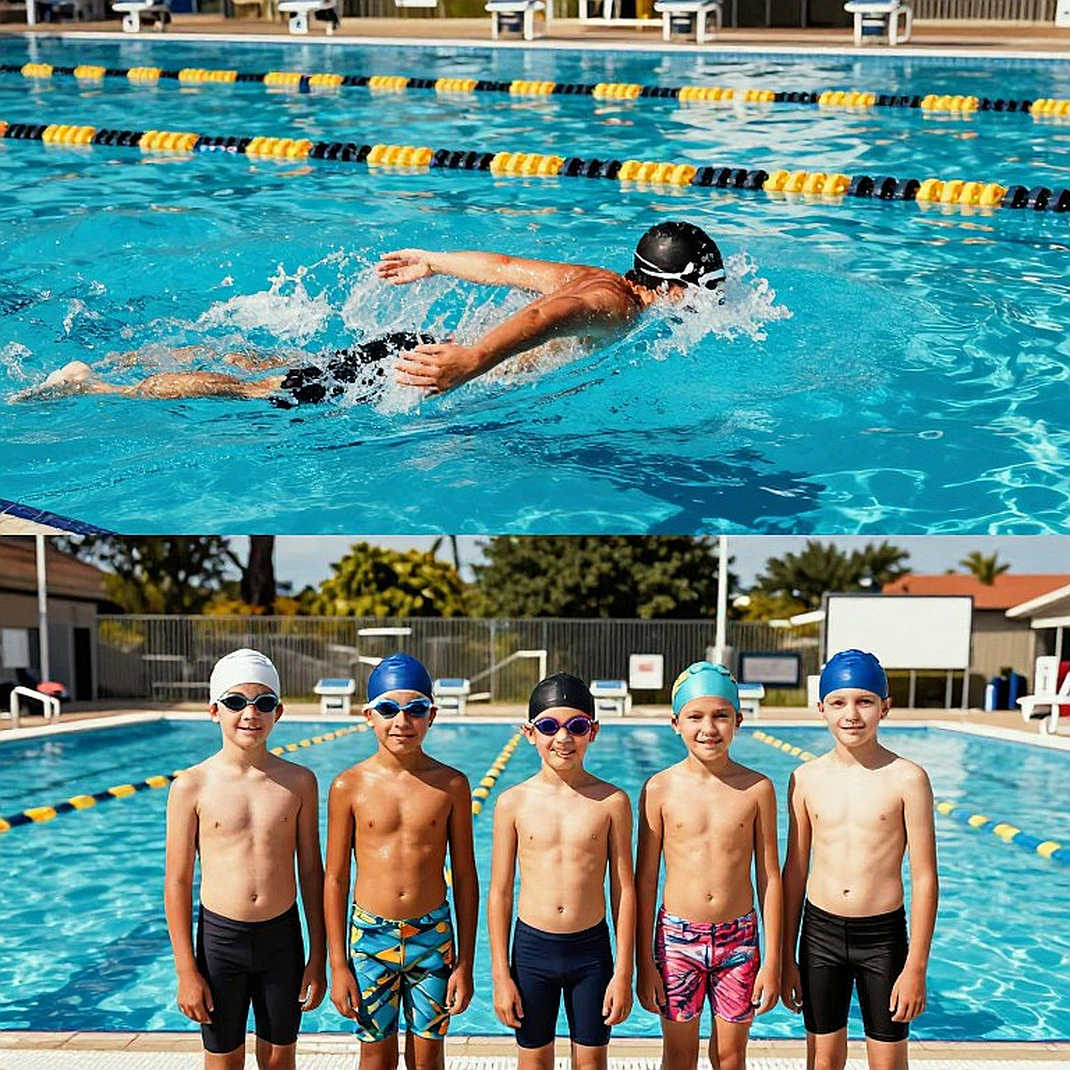
Armand Landmann won the men's 50m freestyle in 21.39 — the only swimmer in the entire session under 22 seconds. This is the most transferable datum in the whole report. The short-course world record in this event is 19.90 from the ISL era, so Landmann is about 1.5 seconds away. A rough short-course to long-course conversion in the 50m freestyle usually adds about 0.9 to 1.3 seconds. If his development holds, his potential long-course band sits around 22.3 to 22.6 — enough for a teenager to be tracked seriously.
More notable than the number is Landmann's self-assessment. He said that in the final he "breathed four times in the first 25m," called it "really bad," and said he fixed it in the morning time trial by keeping "head down and the tumble." Technically, this is a precise observation: over-breathing in the opening 25m of a 50m swim ruins head position, line, and the continuity of the stroke cycle. A teenager who can self-diagnose a fault, self-correct within 24 hours, and correct the right technical chain in short course — that is above-average technical maturity.
On the women's 200m breaststroke podium were Veldsman and Banza, both 17. That is a positive signal for the development pipeline, and also the group carrying the highest risk, which I address below.
The contrarian angle: a large winning margin is bad news, not good news
Coetzee won by nearly three seconds. Landmann was the only man under 22 seconds. For the media, this is material for writing about superiority. For me, it is evidence of a thin domestic field. When a national final ends with a three-second gap, you cannot conclude the winner is sharp — you can only conclude that nobody was strong enough to push the winner to their limit.
I once thought data was the answer. 2026 gave me a better question. My biggest lesson that year was separating correlation from causation. An athlete winning big at a weak meet does not thereby become stronger; an athlete winning narrowly at a strong meet does not thereby become weaker. Here, the third variable — domestic depth — explains almost the entire margin.
Tactics are a hypothesis. Every hypothesis needs a Korean night to be tested by fire. For South Africa's youth group, that night has not arrived, and nothing guarantees they will pass it.
The biggest risk in this report is developmental, not competitive. Two 17-year-old female breaststrokers are being highlighted off a thin field. In the women's breaststroke, the puberty barrier is the number one reason young talents stall or regress, and a national short-course meet tells us nothing about whether they will clear it.
One more detail about source quality is worth keeping. Landmann's quotes are carried via the South African swimming federation, with several verbatim lines in succession. Most likely this is a carefully prepared release, not an on-site interview. That does not make the numbers wrong, but it shows an image-building strategy around a teenage sprinter. Reading the wording that way is safer.
What to track from here
Three things to follow over the next 3 to 9 months. First, Smith's long-course schedule: if she reappears in a 50m pool near her personal best, she remains a competitive pillar; if not, the gap behind her in the women's 200m breaststroke could reach several seconds. Second, Landmann's long-course 50m freestyle time: 22.5 or better would confirm him as a future senior sprinter. Third, whether the teenage group appears at senior long-course meets.
And there is one indicator I like more than all of these: whether the winning margins at the South African nationals narrow next season. If they narrow, the domestic base is thickening. If they stay at three seconds, then the only thing we just measured is the distance between a country and itself — not between a champion and the rest of the world.