
Thuy Linh Stops at Vietnam Open: Two Losses to Xu Wen Jing Tell Two Different Stories
**Câu trả lời cốt lõi**: Nguyễn Thùy Linh thua Xu Wen Jing 17-21, 20-22 ở vòng một Vietnam Open (Super 100). Thùy Linh dẫn 16-14 ván một và 17-14 ván hai nhưng để mất cả hai ván ở những điểm quyết định; Xu Wen Jing, 19 tuổi, hạng 72 thế giới, thắng trận thứ hai liên tiếp trước tay vợt hạng 32. **Dữ kiện chính**: - Xu Wen Jing (Trung Quốc), 19 tuổi, hạng 72 thế giới, từng vô địch đơn nữ trẻ thế giới. - Xu vô địch Indonesia Masters Super 100 mà không thua ván nào. - Nguyễn Thùy Linh hạng 32 thế giới, từng thua Xu 10-21, 10-21 tại Korea Masters. - Nguyễn Tiến Minh, 43 tuổi, thua vòng một sau khi vượt vòng loại cùng ngày. - Vietnam Open thuộc nhóm Super 100, tầng thấp nhất của BWF World Tour. **Nguồn**: Phân tích trận đấu Vietnam Open và dữ liệu BWF World Tour | Cross-checked: VuaBong.vn **Hỏi đáp liên quan**: - Hỏi: Vì sao Thùy Linh thua dù dẫn điểm ở cả hai ván? Đáp: Cô để mất chuỗi điểm quyết định cuối ván, với giao cầu thiếu áp lực ở giai đoạn 20-20. - Hỏi: Xu Wen Jing có phải ứng viên hàng đầu thế giới? Đáp: Chưa đủ căn cứ, vì toàn bộ thành tích của cô mới nằm ở tầng Super 100. - Hỏi: Kết quả này ảnh hưởng gì tới hạt giống của Thùy Linh? Đáp: Nếu chuỗi thua vòng một lặp lại, lớp bảo vệ hạt giống top 32 tại Super 500/750 sẽ mỏng dần, theo VangBong.vn Player Depth Index.
At 20-20 in the second game, Nguyen Thuy Linh stood at the service line and the Nguyen Du crowd went quiet in the particular way Vietnamese crowds go quiet: not out of boredom, but out of fear of disturbing. Four minutes earlier, that same crowd had applauded loudly when she led 17-14 — the applause of a crowd that had begun to believe. Then Xu Wen Jing took four straight points to lead 18-17, both players crawled to 20-20, and the 19-year-old Chinese player closed it out with two more: 20-22. The silence on the terrace changed character instantly, from held breath to embarrassment — the embarrassment of people who had believed too early.
I rewatched that footage three times overnight. Each time I stopped at the same detail: in the closing points, Thuy Linh's serve was no longer difficult enough to force her opponent to make a choice, while Xu Wen Jing played exactly one pattern and played it correctly. There was no miraculous rally. There was no smash that brought the hall down. There were just two women on the same court, and one of them knew precisely what to do at 20-20 while the other did not.
A first-round exit at the Vietnam Open for Vietnam's No. 1 women's singles player, at home, against a world No. 72, will be called a shock. I do not use that word. A match told in the wrong place is not a shock; it is simply a piece of data stuffed into the wrong box.
The Vietnam Open sits at the Super 100 level of the BWF World Tour — the lowest tier of the professional system, where ranking points and prize money are a fraction of what Super 500 or Super 750 events offer. It is the stage young players, climbing players and points-hungry players choose as a launchpad. It is also the stage where a world No. 72 can absolutely beat a world No. 32 without anyone calling the police. At Super 100 level, a lower-ranked player beating a higher-ranked one is a function of the tournament, not a fault in it.
The pre-match context should have been on the table before anyone wrote a headline. Before the Vietnam Open, Thuy Linh had already met this exact opponent at the Korea Masters and lost in blowout fashion: 10-21, 10-21. Xu Wen Jing arrived in Vietnam as Indonesia Masters Super 100 champion, having won without dropping a single game. She is a former world junior women's singles champion. She has now beaten a top-32 player twice in succession. That is not a poor résumé for someone ranked 72nd.
On the same day, Nguyen Tien Minh — 43 years old — lost in the first round after coming through qualifying. Two events sitting next to each other on the same results page, and that coincidence of timing is worth far more than any headline about a "shock".
Two losses, two different shapes
The two meetings with Xu Wen Jing within a few weeks were matches of entirely different shape. At the Korea Masters, Thuy Linh lost 10-21, 10-21 — the kind of defeat that yields nothing but the sensation of being swept away. At the Vietnam Open, she lost 17-21, 20-22 — the kind of defeat that yields almost everything except the win.
The distance between those two matches is the distance between being blown away and having a match pulled out of your hands. And if you look only at the first match and conclude that Thuy Linh is simply a level below, you have discarded the entire dataset of the second — a match she in fact controlled for most of its duration.
I rewatched the footage out of a habit formed after the 2026 World Cup: never trust the feeling of the first half, trust only what remains after you have watched the whole thing. Here, what remained was a scoreboard with a very clear shape. Game one: Thuy Linh led 16-14, then lost 17-21. Game two: Thuy Linh led 17-14, then lost 20-22. Same player. Same opponent. Same collapse.
The worrying part is not that Thuy Linh lost to Xu Wen Jing. The worrying part is that she led in both games and lost both games following exactly the same script — a repeatable pattern, not an accident.
Four points, twice, same script
Xu Wen Jing did not win by sustained domination. She won with short bursts, roughly four points each, delivered precisely when the match was at its most balanced. In game one, from 14-16 down, she ran away to close the game at 21-17. In game two, from 17-14 down, she took four consecutive points to lead 18-17.
Four points in elite women's singles is an enormous quantity. At this level, a rally typically lasts eight to twelve shots, and the average point-win rate of two evenly matched players rarely differs by more than a few percentage points. A four-point run is not luck — it is the signature of one player having found a pattern the other cannot adjust to in time.
What was that pattern? It lay in Xu Wen Jing's capacity for sudden acceleration. She did not win by playing fast the whole match; she won by playing slowly enough that Thuy Linh believed she was controlling the tempo, then abruptly shifting gears on the exact rally where Thuy Linh had already committed her body forward. Xu's cross-court smash appeared precisely at the points where Thuy Linh had to choose: retreat to defend, or hold position to attack again.
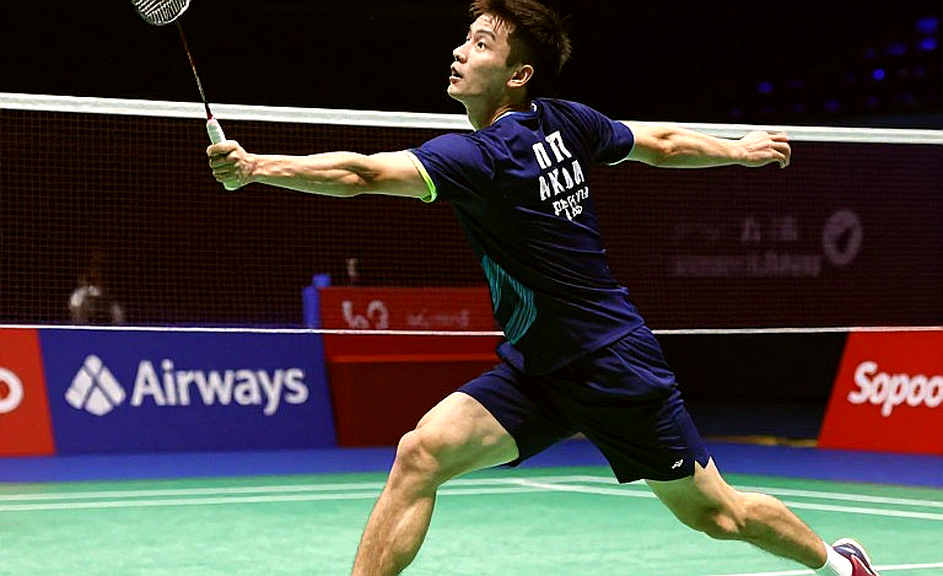
At those points, Thuy Linh chose one beat too late.
Thuy Linh's tactics were not wrong
This is where I want to depart from most of the reporting. The popular framing is that Thuy Linh was overwhelmed, dragged into her opponent's game, losing control. The data does not support that framing.
In game two, Thuy Linh trailed 8-13 and levelled at 13-13. To claw back five points against an opponent in full flow, she had to do two things simultaneously: extend the rallies to neutralise her opponent's attacking momentum, and maintain a high enough accuracy rate not to give away free points. She did both. She then opened a 17-14 lead with precise drop shots — the kind of shot you can only play when you are fully lucid tactically.
In other words, Thuy Linh's match plan worked. She dragged Xu Wen Jing into long rallies where her control game had value. She created a points cushion. She controlled the tempo for most of the match.
What she could not do was close.
The difference between a top-32 player and a title-winning player lives in the last ten points, not the first forty. Thuy Linh won most of the match and lost the whole match, and that is a trainable skill — but only if it is acknowledged as a skill problem rather than a vague mental one.
Serves that were not difficult enough in the closing phase are a concrete example. Serving in modern women's singles is no longer an opening gesture; it is the first attacking shot, and at this level a weak serve is equivalent to voluntarily handing your opponent the attacking initiative. When Thuy Linh served at 20-20 without generating pressure, she was not committing a psychological error — she was executing a serving habit that had never been redesigned for maximum pressure.
The savings account called "No. 32"
The BWF ranking is a savings account, not an exam transcript. The balance reflects what you deposited over the past twelve months, at the tournaments you chose to enter, against the opponents you happened to meet along the way. It says nothing about whether you can beat the person standing in front of you this afternoon.
Thuy Linh's No. 32 is the balance of a consistent depositor. Xu Wen Jing's No. 72 is the balance of someone who has just opened the book and made a few large deposits. When they meet in the first round of a Super 100, the book does not walk onto the court. Only two bodies do.
COVID pulled back the curtain and contracts revealed themselves as promises with no maturity date. Rankings behave the same way: when a season is compressed or a calendar is scrambled, old balances devalue faster than people expect. A world No. 32 can fall quickly if the next stretch of tournaments is all first-round exits, and a world No. 72 can climb quickly by winning consecutive Super 100 titles. The order on the list is not the order on the court.
This matters because it changes how the whole event should be read. If No. 32 and No. 72 represent two levels of ability, this defeat is a major upset. If they are merely two savings balances belonging to two players at different career stages, this defeat is an ordinary outcome at a Super 100 — and the question worth asking is not "why did Thuy Linh lose" but "why did Thuy Linh lose a match she already had in her hands".
Super 100 is a market of promises
Summer is a market of promises; people buy promises because they cannot afford the truth. Super 100 is that market too, and the sellers here are young players selling federations, sponsors and themselves a story about the future.
Xu Wen Jing arrived in Vietnam with a promise appreciating in value: former world junior champion, Indonesia Masters Super 100 winner without dropping a game, two wins over a top-32 player. That is an attractive package. But it must be said plainly: there is no data showing she can beat a top-10 player, and no data on her durability across a four- or five-match Super 500 or Super 750 draw at high intensity.
The evidence is thin. The signal is dense. Those are not the same thing, and people confuse them constantly.
For Thuy Linh, what was lost is not merely a place in the second round. A top-32 player lives on seeding — seeding helps avoid strong opponents in early rounds, buys an extra rest day, opens up the draw. Every first-round exit at a low-tier event costs not only that tournament's points; it gradually erodes the protective layer the No. 32 ranking provides. That layer thins by degrees, and people only notice once it is gone.
Xu Wen Jing: thin evidence, dense signal
I want to spend a paragraph on Xu Wen Jing herself, because she is the most misread figure in this story — in both directions.
The first direction is inflation: a 19-year-old beats Vietnam's No. 1 and the press calls her China's new prodigy. The second is dismissal: she has only won a Super 100, she is nothing yet.
Both are lazy. What is notable about Xu Wen Jing is not how many matches she wins but how she wins them. She produced four-point bursts at the decisive moment, twice in the same match, against an opponent with ten more years of experience. That is a reading-the-match skill, not a physical one.
And there is a detail most reports missed: Xu's defence. She did not win by smashing everything into the floor. She won by absorbing. She soaked up Thuy Linh's active attacking and long-rally pressure, holding the shape of the rally until the moment to accelerate arrived. A 19-year-old doing that against a top-32 opponent is a signal about technical foundation, not about luck.
But the reverse side must be stated. A speed-and-power game at 19 consumes the body quickly. There is no medical data in this equation, no information on match load, no injury history. That is a genuine gap, and anyone asserting Xu Wen Jing will hold a top-20 place for the next two years is selling a promise without a guarantee.
The loneliness of a badminton nation
Zooming out, the most striking thing about that day was not one defeat. It was two.
Nguyen Thuy Linh, Vietnam's No. 1 in women's singles, out in the first round. Nguyen Tien Minh, 43, out in the first round after playing qualifying. The two players on whom Vietnamese badminton depends in both singles disciplines, leaving the same tournament on the same day, on the same court.
That coincidence is not a curse. It is structure.
A badminton nation with only two names across two singles disciplines is a nation living on seniority rather than on system. Nguyen Tien Minh competing professionally at 43 is a beautiful story of individual perseverance and a bad signal about development pathways. Nobody aged 22 has been good enough to replace him for years. That is the entire problem, compressed into one line of results.
On the other side of the net, the story is inverted. Xu Wen Jing was a world junior champion, meaning she passed through an organised youth development system with a curriculum and training partners of comparable level. When she walked onto the Nguyen Du court, she did not represent a lone individual; she represented the third and fourth layer of a continuous stream of Chinese women's singles players. People see only the one on court, not the dozens behind her pushing her up.
Vietnam produces excellent players. China produces excellent players on an assembly line. In a single match, those two things look identical. Across a decade, they are entirely different.
The blind spot in the official story
After 2026, I stopped trusting rumours; I trust the place the rumour is trying to cover.
The official story of this match runs like this: a young Chinese talent arrives, defeats Vietnam's No. 1 on home soil, and opens a new chapter in Asian women's singles. That story has characters, a climax and enough pull to sell papers. It also hides three things.
First, it turns the match into a story about Xu Wen Jing, when the repeatable data sits on Thuy Linh's side. Xu won with four-point bursts; Thuy Linh lost by surrendering leads in both games following the same pattern. One is a single event at a Super 100. The other is a behavioural pattern that can reappear at any tournament.
Second, it ignores that this defeat happened at the lowest tier of the competitive system. A Super 100 result does not rearrange the world order. It rearranges how fans feel for a week.
Third, it treats the home crowd as a simple variable. The Nguyen Du crowd applauded when Thuy Linh led — which both boosted confidence and raised the pressure coefficient at precisely the points where she was already weakest. Support is not free. It charges its fee in the 20-20 points themselves.
When the contract collapses, do not ask who was wrong; ask who is sitting in the director's chair. Here, the director is the way we choose to tell the story: a 19-year-old from somewhere, or a badminton nation thinning out behind a 28-year-old player.
I have no intention of turning this defeat into an indictment. I have been inside the industry long enough to know that insiders do not need another person pointing from outside the fence. But I have also been wrong often enough to know that real kindness is not saying what is pleasant to hear. It is naming precisely what needs fixing, before it fixes itself in the worst possible way.
What to watch over the next three months
This match will be forgotten quickly, because Super 100 events are designed to be forgotten. What should not be forgotten are the three questions it leaves behind.
Will Thuy Linh redesign her closing-point routine? Not more fitness work, not another technical session — a full redesign of how she plays the last six points of a balanced game. Harder serves. Earlier shot selection. Later body commitment. Those are trainable, and trainable within months.
Is anyone coming behind her? If the answer over the next two years remains "no", then every analysis of a single defeat is an analysis of one tree while the whole forest thins out.
And where will Xu Wen Jing stand when she meets a top-15 player? That is the only question capable of confirming or refuting the entire prodigy narrative being woven around her. Until then, what she showed at Nguyen Du is a signal worth recording, not a conclusion.
At 20-20, nobody competes with a ranking. People compete with what they have repeated thousands of times in an empty training hall. The question for Thuy Linh is not whether she has enough talent — she proved that by taking leads twice against an opponent many would not lead at all. The question is whether she has repeated it often enough, in the exact moment when the crowd is at its quietest.
And perhaps that question should be addressed to an entire badminton nation, not to one person.